Supercharged MGA
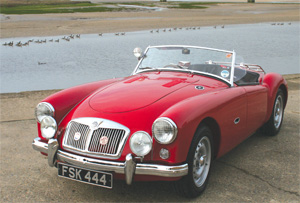
Following a recommendation from Tom Johnson (the owner of the C-type Midget featured in the September 2009 edition) I made my way to Devon to visit Mark Tossell who owns a brace of very impressive MGs. Mark had previously enjoyed a succession of MG models starting with an MG Metro and he has only recently sold his concours MGF Trophy. However, it was Mark’s 1958 MGA that I wanted to see, not only is this MG an immaculate show winner it also has a very unusual specification. Mark prepares his MGs to a very high standard and he’s keen on originality but he also likes to modify and improve them, to achieve this he seeks out appropriate period modifications.
MGA 1500 but now fitted with 1622cc stage two supercharged engine
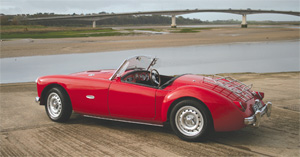
Vents in the front wings direct cool air into the cockpit footwells
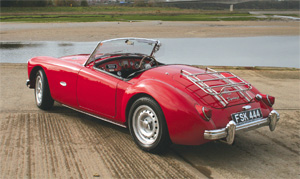
Door fit is an important guide to the integrity of the MGA’s structure
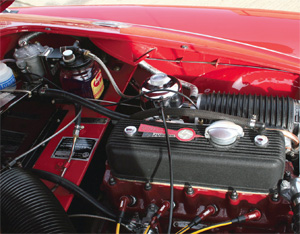
Supercharger fits neatly in the engine bay
The MGA started out as a left hand drive car re-imported back from the United States to the UK. When Mark purchased the car he had intended to keep it left hand drive but after trying to live with sitting on the nearside he found driving it too risky and decided to convert it to right hand drive himself for greater safety.
Although the bodywork looked to be very sound, when he decided to improve the panel fit and refinish the paintwork it was discovered that beneath what appeared to be a solid car there was an alarming amount of rust and filler and the sills needed to be replaced. Once stripped of its paint the offside front wing appeared to have been shot full of bullet holes (very American) and these had all been crudely patched up. Wings and panels had to be removed and new metal welded in to the lower wings, after assembly the result was then re-finished and now the bodywork really is immaculate both on the surface and beneath the skin.
Why Supercharge?
Mark’s always been interested in the background history of the MGA and has acquired a lot of contemporary literature and brochures from the 1950s including old magazine road tests. The MGA was very popular in the United States and his researches unearthed various improvements available at the time, including the well-accepted modification of fitting a supercharger to increase performance. In the 1950s and 60s the Judson Research and Manufacturing Company of Conshohocken, Pennsylvania made vane type superchargers for Volkswagen, MG, Volvo and even Mercedes. Supercharging has considerable appeal in that it brings about a very big percentage gain in performance for relatively little work on the engine, Judson optimistically claimed a fifty percent increase in power, the real figure was closer to twenty five percent which is still a significant increase in performance terms. The unit made by Judson had the added appeal in that it was very compact and fitted neatly inside the MGA’s engine bay occupying the same space as the original twin SUs.
The design of supercharger favoured by Judson, was the sliding vane type. Here, the air/fuel is scooped into the supercharger by a series of sliding vanes mounted on an eccentric hub. As the hub rotates, the vanes are thrown out under centrifugal force and seal against the inside of the supercharger body, pressurising the mixture and finally blowing it out into the inlet port. Inlet temperatures are kept down to reasonable levels as the gases are allowed to expand once they are free of the blower unit.
Temperatures are further kept down by virtue of the fact that the vane type superchargers, being more efficient, usually operate at engine speed, as opposed to being overdriven as with other designs.
As the vanes need to be kept well lubricated, oil is fed to the inlet manifold of the Judson. This oil is drawn into the supercharger by inlet vacuum and, after lubricating the vanes, passes into the engine to be burnt along with the fuel. Judson claimed this helped engine longevity by acting as an upper cylinder lubricant. Incidentally, the lubricant is SAE 10, or Marvel Mystery Oil. Judson warns, “Do not use any other type or brand of upper cylinder lubricant, as most top oils are primarily a cleaner and not a lubricant.”
A colleague of Mark’s who visits the States recently presented him with a well preserved can of Marvel Mystery Oil which was the favoured lubricant for the Judson Supercharger in the 1950s.
Performance
Mark has a copy of the American Road & Track magazine from May 1958, containing an assessment of the performance gains from having a Judson supercharger fitted to an MGA 1500. This table appeared in the test.
| Performance | Stock | Judson Supercharged |
| 0-30 mph | 4.5 | 3.8 |
| 0-60 mph | 14.2 | 12.5 |
| 0-80 mph | 29.0 | 25.0 |
| Standing start 1/4 mile | 19.6 | 18.1 |
This order of improvement, plus a comparison of other data, indicates that the Judson supercharger gives the MG a very close equivalent to 25% more torque and boosts the peak horsepower from 72 to 90, and no more. But the point is that performance is improved as if the 1.5 litre MG engine were enlarged to 1.9 litres.
The disadvantage of vane-type superchargers has always been the rubbing friction of the vanes. Here Judson demonstrated excellent engineering know-how by mixing good common sense with what was then the very latest techniques. The Judson’s vanes are at an angle (not radial), so that the centrifugal forces are virtually, but not quite, cancelled. Additionally, the vanes (or blades) are made from a laminated plastic material, which weighs half as much as aluminium and which is dimensionally stable at all temperatures from 50 degrees below zero to 300 degrees Fahrenheit. A small amount of lubricant is used (about one quart per 1000 miles) but the exact amount is not at all critical. For this purpose, Judson supplies with the kit an aluminium rocker arm cover which incorporates a metering valve.
They summed up the product with, “the best boost in go for the least in dough”.
Mark has experienced a few adjustment problems with the supercharger, partly because the carburettor used is not the most sophisticated device available. However, the car performed very smoothly when I was out on the road with him. A very recent supercharger rebuild prevented any high performance testing but the MGA ran well and pulled cleanly and strongly.
Other Modifications
Mark has fitted a special pair of very supportive bucket seats trimmed in black with red piping which is matched on the interior panels. The dash is standard apart from the boost gauge for the supercharger and the period Radiomobile. There are two intriguing scoops in the sides of the front wings which look a bit like cool air intakes for the engine bay in the style of an AC Cobra but are in fact an American based period modification to cool the MGA’s foot wells and give relief from interior heat to the occupants.
Apart from the supercharger the engine is a 1622 unit modded to stage two with an custom built Aldon distributor. The engine is cooled by a specially built wider than standard aluminium radiator and the bonnet is fitted with louvres to assist cooling. The replica Dunlop knock-on alloy wheels are very like those fitted to the twin cam, Mark feels they blend in really well with the MGA’s lines. The suspension is modified with MGB uprated front shocks at the front and telescopics at the rear. The MGA also has chrome fog and spot lamps plus an additional spot lamp mounted on the windscreen in period rally style.
Today the styling looks so clean and attractive that it is strange to reflect that the launch of the MGA was delayed because when Leonard Lord the head of BMC was shown the prototype in 1952 he had already given the go-ahead for the Healey 100-4 and as there was not enough development funds for both models the MGA was put on hold. As a result, it was not until June 1954 when the traditionally styled TF was valiantly trying to compete for sales with the TR2 and 100-4 (both capable of exceeding 100mph) that the MGA was finally launched. The aerodynamic lines of the MGA are attractive as well as functional which made the sports car so much more competitive and it went on to achieve phenomenal sales in the UK and the United States.
Mark’s MGA is an excellent example in that it has an abundance of charm and great character, while his modifications make it even more interesting. Wherever it goes the lines of the MGA are universally admired, it has won a cabinet full of awards. The quality of the MGA’s preparation is further enhanced by the period improvements that bring the performance and on-the road ability of this car up to a level that matches its sporting appearance.
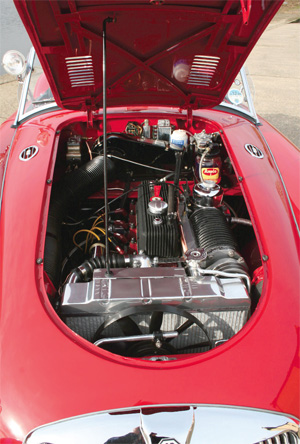
Judson Supercharger and custom built radiator
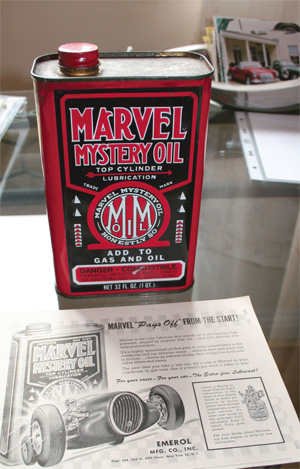
The lubricant is SAE 10, or Marvel Mystery Oil
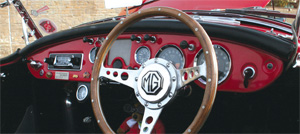
Radiomobile adds nice period touch; note the boost gauge for the supercharger
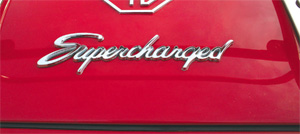
Mark couldn’t resist the Supercharged script
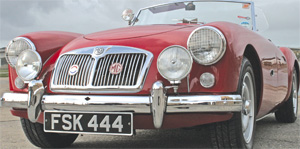
Immaculate chrome work
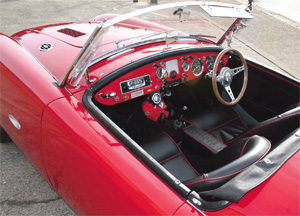
Specially made bucket seats are particularly supportive
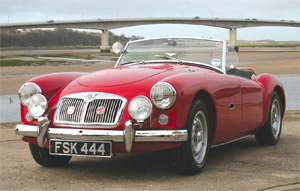
MGA by the River Taw in Barnstaple
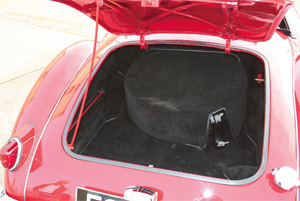
Carpeted boot
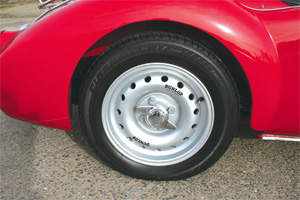
Replica alloy knock-on Dunlop style wheels
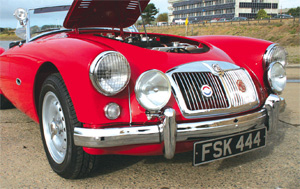
Imposing fog and spotlights and windscreen mounted movable spotlight
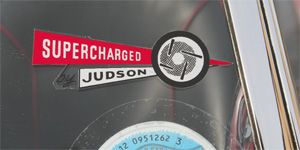
Judson window sticker
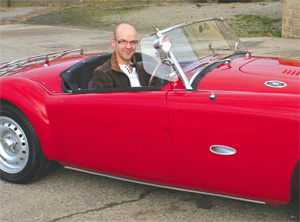
Mark at the wheel
Mark would like to give special thanks to his friend Paul Turner for all the help, advice and support with the MGA.