Dragonfly
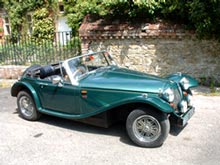
There is always someone who wants something different and motor car design is a frequently chosen avenue for self-expression. The component or kit car industry developed in the 1950s and 60s went through a revival in the 70s and 80s and is still going strong in a few specialist areas today. This industry is largely based on the desire to create something new in car design, sometimes the results can be elegant and occasionally bizarre.
There have been many of these component cars that have copied MGs and also some that were directly based on them. Few kit cars have been MG Midget based although the early Westfield 7 and 11 models used a large proportion of Midget components. Perhaps the most prolific Midget based kit was the Arkley, a special body kit that was the brainchild of Hertfordshire based Morgan and sports car dealer John Britten. A distinguished modsports racing driver Britten experimented with lightweight panels for race Midgets and turned this experience into developing complete body kits for his customers who aspired to a Morgan but couldn’t quite afford one. John Britten’s business was based in Arkley, hence the name. The conversion left the centre body tub of the Midget unmolested but replaced the steel bonnet and front wings with a one-piece bonnet, nose and wings assembly. The Midget rear wings and boot lid were also replaced with a fibreglass back end bonded to the tub. Moulded by the Lenham Motor Company in Kent these panels made the little sports car resemble a cut-down Morgan. Love it or hate it, the Arkley makeover was great fun, although it did appear to be rather too short and stubby for a Morgan look-a-like.
The extra wheelbase lends the right proportion
to the Dragonfly’s traditional 1930s style
The designer of the Dragonfly Dan Pratt had built himself an Arkley in 1978 and as a result was inspired to take the idea of a Midget conversion concept a whole stage further on. In collaboration with Hampshire coachbuilder Steve Watson who had worked on Dan’s Arkley a completely new Midget based car was conceived. The Dragonfly conversion had a very similar approach to the Arkley but addressed the problem of the short body length with the addition of an extra 10 3/8 inches to the wheelbase by fitting an extension to the front end of the chassis. Chassis design consultant Donald Bastow, who had previously worked with Rolls-Royce and Lotus, was called in to ensure that the extension was properly engineered. The front suspension units and steering rack were moved forward onto the new chassis extension, other changes were a lengthened steering column and softer springs at the front, the engine remained in place and the rear suspension was unchanged. This extended wheelbase ensured that the Dragonfly had all the right proportions of a thirties sportscar as well as the other key attributes, flowing wings, runing boards, separate headlamps, long bonnet and an upright grille.
The high quality body moulds for the conversion kit, which mainly consisted of a set of fibreglass panels, were produced by a company called Wincanton Engineering of Bentley, Hampshire. Five main panels made up the body, a one-piece rear end, the right hand and left-hand side wing/body side mouldings, the rear-hinged bonnet and the radiator shell. Other minor panels, such as front apron and inner wheel arches were in aluminium.
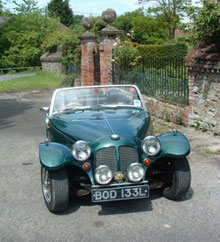
Nicely proportioned Dragonfly
Despite the high quality of its design and construction the Dragonfly conversion was never taken up in significant numbers and currently there are believed to be only three examples in existence, one in the Channel Islands another in Holland plus the car featured in this article. There may be various reasons for this, perhaps the chassis extension added extra complexity to the build, or maybe the cost of the conversion compared to other sports cars of the time made the Dragonfly a bit too expensive. The kit cost £1200 plus a good base Midget or Sprite while complete turn-key cars could be purchased at between £3500- £5000 depending on the age and condition of the base car.
Notwithstanding the quality of the kit and the soundness of the concept the project did not flourish and I had never seen a Dragonfly except in photos. That is, until recently when I received a phone call from Club member Fiona Bolton and an invitation to take a closer look the Dragonfly that she and her husband Anthony owned. Fiona’s father Brian Lemon purchased the Dragonfly in 1982, now christened ‘Bod’ (from its registration number BOD 133L) it was the company prototype and appeared in the company’s advertising. Brian enjoyed driving it until he handed it on to Fiona ten years later. She and Anthony used the Dragonfly regularly and also enjoyed it enormously until the arrival of their two children made it impractical as family transport and sadly the car has rather languished ever since. Fiona is caught between her desire to hang on to the treasured little car and her concern that its condition will only deteriorate if it spends years of idleness shut away in a garage.
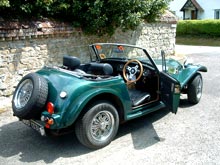
The cockpit and interior trim directly betray
the Dragonfly’s MG Midget origins
The Midget base is not immediately obvious to the casual observer and the Dragonfly easily passes as a complete design in its own right. The underlying Midget has been well hidden and only a few clues give away the car’s origins. The windscreen and doors are clearly Midget but the front and rear sections are uniquely ‘Dragonfly’. The swooping front wings are carried right back with short running boards beneath the doors into neat rounded rear wings giving the bodywork a wider, as well as a much longer appearance. The rounded tail treatment looks the part but means that the original opening boot has been dispensed with, although there is still a rear storage area which is now only accessible through quite a small aperture behind the seats. The wheels are a neat combination of alloy and chrome wire; the spare is rear mounted on the rounded tail in traditional thirties style. The detailing is very good, the headlamps are chrome, as are the torpedo sidelights, grille mesh and radiator cap. The interior is completely standard Midget including the original reclining seats; therefore the hood and tonneau are also standard items making replacement easy.
Under the bonnet the engine bay contains a 1275cc unit which provides all the usual Midget performance and the extra chassis length improves the ride and does no harm to the feel of the car on the road. That long bonnet stretching out before you presents a strange aspect when viewed from inside a Midget cockpit but once on the move the whole car seems right. The Dragonfly is competent, agile and from behind the wheel it drives like a normal production car that was designed as a complete entity from the outset.
For someone who likes the look of a traditional thirties sportscar but also wants the practicality of more modern MG, the Dragonfly has much to offer. Its design and build quality are in a different league from so many other examples of the component car boom. For me much of its appeal rests in that it is built on a properly engineered and developed sports car and therefore can be relied upon to be safe and predictable.
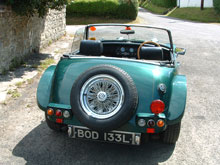
Boot mounted spare, no boot lid but
access to storage area behind seats
Fiona and Anthony are currently unsure whether to keep the Dragonfly or offer it for sale. Overall the condition of the bodywork is very good, although there are a few cosmetic defects in the metallic paintwork and a small area of corrosion at the base of the nearside A post. All the fibreglass panels are fine and the fit and panel gaps are all very good. The hood will need replacing and the interior would benefit from some new trim and carpet. The Dragonfly has a recent MoT, starts on the button and runs cleanly and evenly. If Fiona can be persuaded to part with it the Dragonfly presents a unique but still a very practical proposition. An exclusive retro 1930s design with cheap and cheerful MG mechanical components, historic car tax and bags of character, what more could you ask for? If you would like to own a rare and distinctive MG Dragonfly then contact Fiona and Anthony on ‘Fionabolton1@aol.com’