1939 MG TB at Fishers Garage
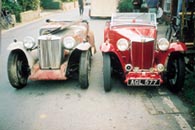
MGTB
Launched in 1939 the MG TB Midget is visually almost identical to the TA that preceded it with only a few small detail differences. The TB has centre laced wire wheels instead of side laced and there are no semaphore indicators beneath the windscreen pillars. The TB’s bonnet side panels have different sets of cooling louvres plus an extra bulge on the nearside to clear the dynamo of the new XPAG engine.
It was really this new engine that chiefly distinguished the TB from the previous TA model. The XPAG engine was a new design and had a cylinder bore of 66.5mm giving a capacity of 1250cc. Although smaller than the TA unit the TB engine put out extra horsepower because it had a larger bore and a shorter stroke and developed its maximum power at 5,250rpm instead of 4,500rpm. The XPAG unit’s stronger block and crank proved to be ideal for further development and it became the power plant of virtually every MG model for the next 15 years. The engine was also ideal for tuning and became extremely successful in competition being adopted by Kieft, Lotus, Cooper and Lister. Perhaps the XPAG engine’s ultimate state of tune was in the Gardner-MG record breaker that topped over 200mph. Sadly production of the TB was cut short with the outbreak of war in September 1939 after only 379 cars had been built.
On arrival Robert’s TB was compared with the TC belonging to regular customer Nigel Jordan |
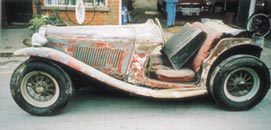 Although in one piece the main body tub could not be saved |
Rare example
Today the TB remains a rare model, which is why Mike Fisher of Fishers Garage of Walberswick near Southwold in Suffolk gave me a call to tell me about the TB project he had in his workshop. This particular TB belongs to Robert Innes who has owned the car since 1971. Back the late 1960s Robert had been the proud owner of an MG PA, registration AFC 17, a car that he greatly enjoyed but had to have it rebuilt after putting it in a ditch. Soon after the rebuild the ill fated PA was struck by another car on trip back from Devon. Robert couldn’t face the thought of going through another rebuild and decided to accept the insurance settlement and let them write off the PA. This was in the days before classic car agreed value insurance and Robert was dismayed to receive only a fraction of the value of the PA and he never did get its true value. Robert was telling this sad story to a colleague on a train journey and his colleague replied that he had a friend in Liverpool who had an old MG T-type for sale, it was not a runner but complete and on its wheels. The owner was off to work in the States and needed to get the car out of the way. Robert made an offer for the TB that was accepted and the car was his. He towed the MG back to his London flat where he was able to tinker with it; he got the engine running but did not get around to putting the it back on the road. After a house move the TB was put in storage where it remained until a suitable time when it could be restored. In the interim Robert briefly owned an MGB which he used for commuting but he always hankered after getting the TB fully rebuilt and when the time was right he entrusted this task to Mike Fisher. Robert is greatly looking forward to the completion of his TB and intends to use it for road runs such as the Regency Run so look out for him at Brighton next year.
Perfect setting
Mike and his wife Clare have been running Fishers garage for the last years ten. They operate in an idyllic setting in a quiet seaside village; their premises have a time warp quality and belong to those days when local garages were small, self-contained and run by ‘real’ mechanics, craftsmen who thoroughly understood every aspect of the cars they repaired. To walk into Mike’s garage is a delight for any classic motoring buff, everywhere you look there are fascinating vintage auto parts and items of genuine memorabilia, there is also the period paraphernalia of Mike’s cycle hire and repair business, where tandems share space with T types. The whole place is like a really well researched film set for a 1960s based drama, except of course it is all quite real. However, the most striking thing is the quality of the finish on the cars in the restoration workshop. On my last visit there was a Morris 1000 Traveller having a total rebuild including a new wooden frame and also an MG J2 which seemed quite tiny by comparison to the TB. Mike has twenty-five years of experience in the trade and rebuilt his first Austin Seven with his father when he was only 14. Mike will restore and repairing any classic, veteran or vintage car and is the sort of bloke who knows exactly where to source any missing part and if it becomes unobtainable he will make a new one. As well as MGs he also has a passion for Rolls-Royces and is currently completing the re-build of a 1928 Phantom 1 and also runs a 1925 Rolls-Royce 20hp. He showed me a nickel plated support for the windscreen that he had fabricated himself, it was indistinguishable from the original. However it’s not just Rolls Royces, Mike will tackle the majority of classics; the last time I called there was a Ferrari Dino in the workshop.
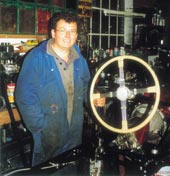 Mike Fisher with the restored rolling chassis |
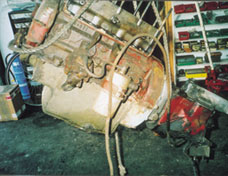 Engine out for strip down and re-build |
TB restoration
On arrival at Fishers, Robert’s TB registration HJO 76 was complete but in need of total restoration, the timber frame body was well-rotted and in a state of near collapse with the rear wings falling away from the centre tub. Most panels behind the scuttle were badly corroded, only a few were recoverable. Mike began by stripping the car completely and after shot blasting the chassis it was found to be pretty sound. In fact Mike suspected that the chassis might have been replaced when the TB was still quite new. The chassis showed no signs of damage or repair, whereas the engine front plate had been broken, and there was also signs of repair to the back plate; evidence that the TB had been accident damaged and repaired at an early stage. With the chassis repainted and up on stands Mike began the gradual process of rebuilding each component before refitting it to the bare chassis.
The restored rolling chassis was soon sitting on its non-standard 16inch wheels with oversized tyres, a period modification which Robert has decided to retain as he feels it has now become a part of his car’s identity. I was immediately struck by Mike’s attention to detail and the very high standard of preparation of all components before he refitted them to the chassis.
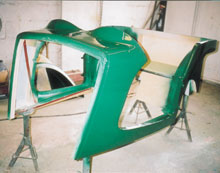 New body tub re-panelled and sprayed in cellulose |
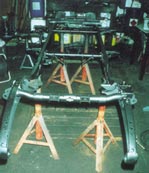 Bare chassis which was found to be straight and sound |
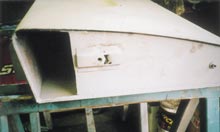 The fuel tank with corroded section removed |
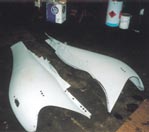 Mike managed to repair the front wings |
Body
The main body tub required a complete new frame which then had to be re-panelled. The re-built body was sprayed British Racing Green in cellulose for a really authentic ‘correct’ finish. The bulkhead had survived pretty well and after thorough de-rusting Mike had repaired and deftly welded up various corrosion perforations and other non-original holes that had appeared over the years. The swooping front wings were corroded, particularly at the join with the running boards and one of them was not of the correct specification, another indication betraying the evidence of an accident very early in the TB’s history. However, Robert was keen to retain the wings and for Mike to rebuild them which he did most successfully and now they blend into the TB’s new running boards perfectly.
Extensive corrosion meant that the rear wings were completely beyond saving. By contrast the fuel tank is original. Although badly corroded Mike was able to repair the tank’s rusted side panel. Mike also cleaned and refitted the fuel filters and feed pipes for the fuel system including the reserve tank.
New wooden floorboards had to be fitted but the central tunnel section is original. Most of the TB’s nuts and bolts were retained to be used in the rebuild and after cleaning they were zinc dipped and clear passivated with a coating of either oxides or phospates to prevent corrosion.
Mike feels that you have to be sensible about deciding what can be retained and what needs to be replaced on a rebuild of this type. As far as is practical and whenever possible he will always repair an original panel rather than resort to a newly fabricated part, the original will fit better and it is always desirable to retain as much of the original car as possible.
Brightwork
Mike dismantled the windscreen frame and then had all the sections re-chromed although on re-assembly the frame was fitted with its original glass. The frame mounted windscreen wiper motor needed to be rebuilt a task undertaken by Mike.
The TB’s headlight bowls needed re-chroming but with the dents left in as requested by Robert. The radiator grille was also re-chromed and then the original enamel MG badge was re-fitted.
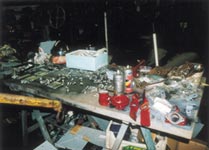 Some of the small items in the process of refurbishment |
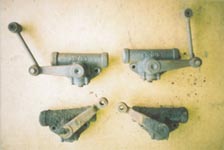 Girling shock absorbers before and after cleaning |
Suspension and steering
The springs, shockers and steering box required complete overhaul before re-installing, as did the front and rear axles. Mike found that the front suspension trunnions were completely worn and had been bodge repaired. The steering box was fully overhauled and Mike then fitted a Tomkins steering kit, a conversion that avoids the need to shim the steering box to make adjustments, any play can be simply taken up by turning a large screw.
Brakes
The brakes were completely dismantled, cleaned and then re-lined. New seals were fitted to the slave cylinders, the master cylinder was overhauled and most of the original brake pipes were re-used, while the handbrake cables had to be replaced.
Engine work
The engine in Robert’s TB is one of the very first XPAG units with engine number 513, the chassis number 0285 makes it the 34th TB built (Abingdon always started their chassis numbers with the factory telephone number of 251). Mike always likes to dismantle and re-assemble engines himself and he uses a local engineering shop for any necessary machine work. Although the TB’s paperwork claimed that an engine rebuild had already been undertaken Mike was dubious about the amount and quality of the work done.
First the cylinder head was re-machined and fitted with new valve seats for unleaded fuel. The block was stripped and as the crank had already been reground it only needed polishing. The cylinder block had been also been rebored and the pistons were OK, but one of the main bearing studs had been sheared, this was replaced and then Mike re-built the block with the original shells and bearings. Also the cam followers and camshaft were completely worn out and the rocker gear was in very poor order, so these had to be replaced along with the camshaft bearings.
The SU HV3 carburettors fitted to the TB when it arrived in Mike’s workshop were from an earlier model and incorrect but he was able to purchase the correct specification SU carburettors from Burlen Services.
Ignition components such as the original distributor were re-built, while the starter and dynamo were overhauled and then all these components were treated to a brand new wiring loom.
Centralised chassis lubrication system
The TB was supplied with a chassis lube system, consisting of a network of copper pipes that allow the chassis to be lubricated; they served the front and rear spring trunnion boxes and the hand-brake cable. The idea is to facilitate regular lubrication with EP 140 heavy grade gear oil and this is applied via set of nipples either side of the engine bay. Mike found that this system had been blocked for some time, a common problem usually caused by someone attempting to apply heavy grease via the nipples. Mike was able to re-use most of the original pipe work but had to re-fashion some new sections.
Hood and trim
The hood that came with the car was an after market item from the 1960s but Mike judged it good enough to retain but the sidescreens had to be recovered on the original frames. However the interior trim was badly decomposed and it was decided that it all had to be replaced.
The dashboard was reused after good clean but the black steel central instrument panel was refurbished complete with the white lettering describing the functions of the switchgear. While the main instruments were sent away for restoration their was some debate about the temperature gauge. This was another after-market addition and Robert had wanted it retained, in this instance Mike pointed out that it would cost much the same to replace it with the correct specification gauge as it needed to be re-built anyway.
In-depth restoration
To simply describe the labour and parts required to restore a classic as I have done here does not do justice to the full extent of actual work involved in a rebuild of this type. Mike works quickly and even fits in other projects alongside and these are also predominately total rebuilds. As an occasional visitor to Walberswick, progress on the TB always seemed dramatic to me, as the car seemed to undergo a major transformation every time. However my own limited experience of this type of endeavour makes me well aware that this is but a snapshot view of the project which fails to capture the painstaking attention to detail that an experienced restorer will achieve. Every part of the TB has been dismantled, cleaned and refurbished or replaced and the car now looks much as it did when it first drove out of the gates at Abingdon just before the Second World War.
Mike and Clare run a small but efficient business and the quality of their work is quite stunning. Mike will tackle almost anything that comes through the door. On my last visit he showed me a rebuilt and re-sprayed Frogeye Sprite that he was just finishing off, also to a very high standard. If you’re contemplating a rebuild and looking for a real restoration specialist who can cope with the bespoke and the unusual then take a trip to the seaside and pay Mike a visit.