Goodwood Revival
Over 94,000 classic motor sport fans flocked to the Goodwood Revival in September to attend a truly unique classic motoring event, perhaps best described by founder Lord March as a ‘magical step back in time’. Meticulous planning and careful organisation ensure that the weekend feels exactly right. All the vehicles taking part are pre 1966, even the bicycles. While everyone with an active role in the event from drivers, mechanics, support staff and the press wear appropriate 1950s clothes. The ‘dressing-up’ has become so popular that now many of the spectators also make a point of blending in by wearing correct outfits, all of which gives the weekend an authenticity unknown at any other race meeting.
After several years it would not be surprising if the novelty of the Revival might begin to wear off, but this far from the case, perhaps because each year the event has been re-invented with something different, a new surprise or unexpected thrill for the spectators. For me, the motor racing itself was enough to justify the weekend. Being able to watch so many wonderful cars driven with such skill and commitment is quite breathtaking. Access to the circuit is very good and if you don’t mind a walk even on Sunday, the busiest day of the weekend, you can still find somewhere to get a good view of the racing action. If you’re not keen on walking then you can hitch a lift on the regular tractor and trailer service; of course the tractors are all appropriate 1950s and 60s classics.
There were numerous distractions to the motor racing, including spectacular aerial displays with Spitfires and Hurricanes this year featuring a rare Russian fighter plane the Lavochkin La-9. Keeping with the Russian theme there was also the site of a crashed Sputnik complete with a group of Russian soldiers to guard the wreck. While a platoon of Home Guard all bearing a remarkable resemblance to the cast of Dad’s Army was also on patrol, all these theatrical touches added an extra dimension to the weekend.
Out on the circuit this year’s Revival had many great moments but perhaps the most exciting race of the weekend was Sunday’s Royal Automobile Club TT Celebration. The race featured a tussle between Juan Manual Fangio II (nephew of his illustrious five-time World Champion namesake) in a bright yellow E-type Jaguar and Mark Hales in the red ISO Bizzarini A3C. A particular highlight was when Mark Hales re-took the lead from Fangio in the final moments of the race with smoke pouring from the back the Bizzarini, great stuff.
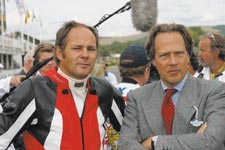 Gerhard Berger and Lord March, photo Richard Hampson |
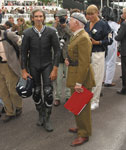 Damon Hill and Murray Walker among the many celebrities at Goodwood, photo Richard Hampson |
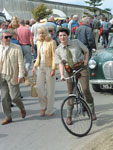 Land girl provides typical Goodwood glamour |
Missing MGs
At first glance the racing programme looked rather disappointing to the MG devotee, although on closer inspection the MGs were still there but this year appearing in modified and special bodied form. Sunday’s Fordwater Trophy certainly offered an interesting assembly of very specialised sports cars, described in the Goodwood Revival Catalogue as ‘production based aerodynes’. All the cars were from the early sixties and all were fitted with lighter and more aerodynamic bodies than their original base production cars.
Of great interest to MG and Austin Healey fans was a collection of Douglas Wilson Spratt’s re-bodied aerodynamic Sprites and a similarly re-bodied MGB. These were called WSM’s, short for Wilson-Spratt McManus and often pronounced ‘Wuzzum’. These handsome little coupes originally had aluminium panelled bodies with later cars having a combination of alloy and fibreglass. The elegant WSM MGB was driven by Tony Wilson Spratt, while the WSM Sprites was driven by Paul Woolmer, Ian Guest and David Gathercole. In addition there was a very pretty yellow Austin Healey Sebring Sprite driven by Ron Gammons. This little coupe was also based on an early Wilson-Spratt design and was campaigned in the 1960s by Peter Jackson. The roofline was lower than the later WSMs and Jackson’s car did not run under the WSM name but raced as a ‘Sebring Sprite’. There was a Speedwell Sprite on the grid owned by Antonio Bertini and driven by Michele Tommasi, who has recently joined the MGOC Race Championship, plus two more Sebring Sprites, driven by Christopher Clegg and Martin Davidson.
Another celebrated fastback coupe appearing in the Fordwater Trophy was the Jacobs Midget. After the announcement of the MG Midget in 1962 Dick Jacobs an enthusiastic MG racer sketched out the sleek fastback design and persuaded John Thornley and Syd Enever to initially build a pair of special bodied coupes for him at Abingdon. An innovative construction method was applied to these coupes in that the special aluminium body panels were fixed to the steel subframe with Araldite epoxy resin adhesive. A third coupe was built which was sold to John Milne and this Jacobs Midget has continued in competition throughout its career, remaining very active in historic motor sport it was to compete in the Fordwater Trophy in the hands of James Willis.
The remaining Abingdon based entry was Barry Sidery Smith with his left hand drive 1964 MGB fixed head Berlinette Coupe. This coupe conversion was designed and built by Belgian Jacques Coune and based on the MGB. Its fixed roof contained a deeper front screen and much of the MGB’s rear bodywork was replaced with fibreglass panelling. The Berlinette cost nearly 50% more than the original MGB and only one right hand drive example was produced but 55 left-hand drive models were built.
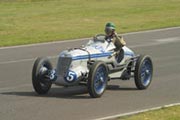 Gerhard Maier with his R-Type, photo Richard Hampson |
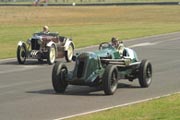 Elizabeth Wigg’s 1930 MG M Type Double Twelve behind Keith Schellenberg’s 1933 Bentley Bamato Hassan Special, photo Richard Hampson |
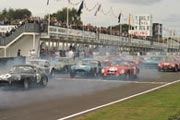 Start of the RAC Tourist Trophy Race Start of the RAC TT, photo Richard Hampson |
In keeping with the special bodied theme the remainder of the British cars consisted of an elegant SLR bodied Triumph TR4, a TRS Le Mans, a Sunbeam Alpine Le Mans and a Sunbeam Alpine Harrington. The final British entrant was the diminutive Mini Marcos driven by Rae Davis, a very accomplished MGOC and classic car racer. The Marcos is essentially a lightweight, monocoque, fibreglass GT body and was a popular conversion in the 1960s, utilizing a Mini front subframe and running gear.
The rest of the grid was made up with a selection of exotic continental cars; five Zagato bodied Alfa Romeo Guilia TZs, three Porsche 904 GTS and a Porsche Arbath Carrera GTL.
The Fordwater Trophy
The race promised to be very interesting as the field assembled in the Collecting Area with powerful machinery such as Alfa Romeo TZs, and Porsche 904s lining up against the seemingly more humble British offerings.
On the fall of the flag Irvine Laidlaw in his Porsche 904/6 (31) and Willie Green’s Alfa TZ2 (5) raced towards Madgwick corner from the start line. Laidlaw briefly leading and the whole field trying to avoid line of spilt oil through Woodcote Corner but by the chicane Willie Green had taken the lead.
Alfas and Porsches followed en mass but David Gathercole’s red WSM Sprite (24) came gamely through in 7th place and proceeded to make up two places on the second lap.
Paul Woolmer’s WSM Sprite retired on lap 2 and was followed by Frers’ Porsche 904 (lap 3) and David Wylie in his Speedwell Sprite (lap 4).
At this stage of the race Rae Davis, driving the diminutive Mini Marcos (15) had begun to gain dramatically on Gathercole’s WSM Sprite and while Green was beginning to catch the tail enders, sadly on lap 6 Gathercole took to the pit lane with a sticking throttle cable. He was able to rejoin the race after a few minutes spent correcting the problem but was by now well out of contention.
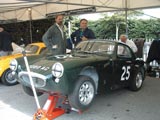 Preparation of Martin Davidson’s Sebring Sprite for the Fordwater Trophy |
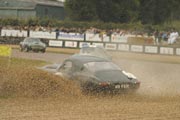 Sunday’s RAC TT Celebration race – Lightweight E-Type takes to the gravel, photo Richard Hampson |
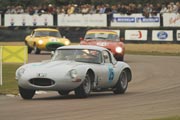 Gregor Fisken/Emanuele Piro’s 1962 Lightweight E-Type with Peter Hardman/Patrick Tambay Ferrari 330 LM/B and the Fangio/Gary Pearson E-Type following, photo Richard Hampson |
The Sunbeam Alpine of Harrington (21) continued to lap in stately fashion at the tail of the field together with Otto’s Triumph TRS (23) both making steady but courageous progress.
At this mid race stage, James Willis in the little Jacobs Midget Coupe (14), Ian Guest’s WSM Sprite (29) and the Sebring Sprites of Ron Gammons (9) and Christopher Clegg (10) had all been dicing throughout, and were holding their heads high, competing well with one of the Alfa TZ1s. However the emerging star of the race had become Rae Davis in the Mini Marcos as he regularly swept through the Chicane on three wheels and by holding a tighter line through all the corners he was gaining steadily on the leaders.
With too few laps remaining for the Marcos to make any further impact Rae Davis had to settle for fourth position, which for the little car was very creditable. Willie Green won in the Alfa Zagato TZ2 while Irvine Laidlaw was second in the Porsche 904/6 and Joe Colasacco third in the Alfa TZ1. The dedicated classic car enthusiast and Pink Floyd drummer Nick Mason brought his Alfa TZ1 home in sixth place. James Willis in the Jacobs Midget was 9th. The rest of the Abingdon based aerodynes finished behind Willis in the following order: Ian Guest WSM Sprite, Christopher Clegg Sebring Sprite, Ron Gammons Sebring Sprite, Barry Sidery-Smith (MGB Berlinette), Michelle Tommasi (Speedwell Sprite), Martin Davidson (Sebring Sprite), Tony Wilson-Spratt (WSM MGB) and finally David Gathercole who had to pit to release his sticking throttle.
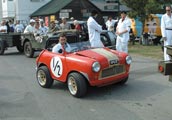 Much reduced Mini |
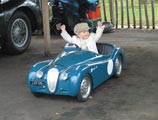 XK 120 and a winning driver displays celebratory mood in the paddock |
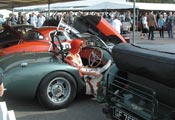 Relaxing in the paddock and catching up with the news |
For me the Fordwater Trophy held the most direct interest and I was particularly impressed with the performance attained by the Spridget based WSMs, Sebrings and the Jacobs Midget. While Hugh Taylor’s Alfa Romeo TZ1 with 1570cc was lapping at an average of 83.36 mph, James Willis in the Jacobs Midget with only 1138cc was just behind him at 83.24 mph. The thinking behind these lightweight aerodynamic Spridget coupes was to maximise power to weight ratio and make the very best of the A-series engine’s output. The astonishing performance of these pretty little cars around Goodwood was a credit to the skills of the drivers and also to Douglas Wilson-Spratt and all the other engineers and designers who developed so many rapid variants on the Spridget base.
Goodwood continues to generate its unique charm and provides an excellent weekend of constant entertainment for the classic car enthusiast, an event not to be missed.
The next Revival meeting will take place next September 2004 on the 3rd, 4th, & 5th.
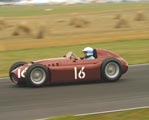 Richmond and Gordon Trophy – Jochen Mass in the Lancia D50 A, photo Richard Hampson |
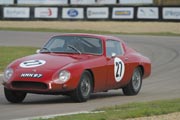 Fordwater Trophy – WSM MGB underway driven by Tony Wilson-Spratt, photo Richard Hampson |
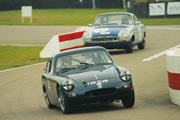 Fordwater Trophy – Handsome Jacobs Midget with James Willis at the wheel, photo Richard Hampson |
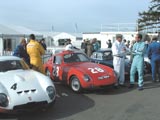 Collecting area – Fordwater Trophy, Alfa TZ and WSM Sprite |
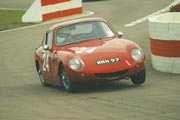 Fordwater Trophy – David Gathercole put in a truly blistering performance in the WSM before a sticking throttle forced him into the pits, photo Richard Hampson |
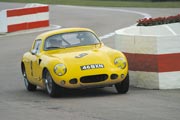 Fordwater Trophy – Ron Gammons in the Austin Healey Sebring Sprite, photo Richard Hampson |
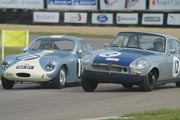 Fordwater Trophy – Michele Tommasi in the Austin Healey Speedwell Sprite and Barry Sidery-Smith, Coune Berlinette, photo Richard Hampson |
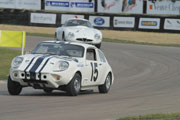 Fordwater Trophy – MGOC racer Rae Davis made dramatic progress in the Mini Marcos GT, photo Richard Hampson |
The 2003 Goodwood Revival was the most successful yet with a record attendance over the three-day event. Below are the special awards presented by the Earl of March at the prize giving on Sunday evening:
Driver of the Day
Mark Hales
Spirit of Goodwood Trophy
Peter Procter
Best Presented Team
Paul Stanworth – BMC transporter & Broadspeed Mini Team
Fastest Lap of the Meeting
Frank Sytner – Lola-Chevrolet T70 Spyder – 1:22.756
Fastest Lap by a Lady Driver
Desire Wilson – AC Cobra Le Mans Coupe – 1:32.415
Fastest Lap of the Glover Trophy
Thomas Bscher – BRM P261 – 1:26.053
Will Hoy Memorial Trophy:
Grant Williams – Jaguar Mk 1
Richard Ladds