Playing the Right Tune B series engines
The first in a two part examination of B series tuning options.
Previously we looked at some of the simpler tuning options for the A series engine. This time we examine the A series’ big brother, the B series. Once again I am deliberately not going to get too exotic with engine tuning specifications, that can come later with specific coverage of super or turbo charging and similar modifications, but there will be more in depth suggestions for the B series than for the A series.
The same desires for improvement apply to MGB owners as with MG Midget owners. That is, while they enjoy their cars perhaps there is the need for them to be a just little more competitive in today’s traffic conditions? The principles of improvement are the same for the B series engine as the A series, but unlike the small brother, the B series is generally far less responsive to change. Which means that for comparative improvements in percentage terms you have to do more work and spend more money. B series cars generally have a significant advantage over the A series cars since the running gear that comes as standard is far more robust and can accommodate much higher power and torque gains comfortably.
We must remember that the B series is now over 50 years old and so this should tend to put some of the performance shortcomings in perspective (I certainly don’t perform as well these days). However there is still much that can be done to improve the MGB’s performance and without destroying the driveability, economy and reliability of the engine.
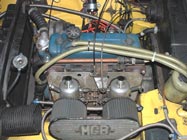
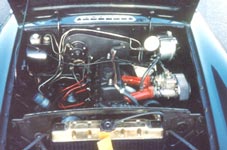
Apparently standard engine bay conceals a considerable up-rate in power output through close attention to detail |
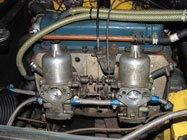 The original twin SUs are underrated |
Before tuning though comes the need to examine all the other aspects of the car that will ensure safe operation. Obviously most tuning will be carried out on MGAs and MGBs as there is far less demand for tuning of the ZA and ZB Magnettes and even less for the Farina Magnettes. Let us not ignore the Magnettes though and specifically mention that 1800cc MGB engines and overdrive gearboxes have been fitted in the past. This may seem tame, but it represents a 40% power hike with greater torque to match! The problem here though is that such increases also demand extra work with brakes and suspension.
The MGA 1500 tends to sit in the same rather exposed position of needing brake upgrades for anything more than a mild 10 to 15% power increase. The later 1600 models however can handle significantly more power through their standard front disc, rear drum set ups, as long as they are in tip top order. The same applies to the MGB as both 1600 MGA and MGB do have efficient brakes with quite a degree of untapped reserves. There is also a reserve in the areas of suspension and handling, plus most cars will be operating with modern tyres which offer significant advantages over any period tyre.
Having established that you are able to stop from higher speeds with extra power, as well as exit corners in the right place and facing in the right direction, it follows that you will also want to get to the next corner without breaking down. Here too the reserves of the B series engine will allow quite significant increases in power that will not result in any consequential alteration to the service life of the engine, subject of course to correct building and proper maintenance. This resulting from the mild 50 to 52bhp per litre seen in the ‘high powered’ MG specifications.
Getting down to details…
Now let’s look at the engine and how to improve its output. Visual similarities to the A series also charts the path to follow with the most significant gains coming from modifications to the cylinder head. With mainstream capacities varying from 1489 to 1798cc over such a long production life, there is a huge variety of cylinder heads, many of which can be interchanged. However, the gains made from standard head swaps on an A series does not apply to the B series engine. Even so, it is worth identifying the better heads as it can save effort and money in the modification programme. Early 18V series engines as found on 1971 to 1973 MGBs probably have the best standard head and these carry the casting number 12H2709 on the top of the head face under the rocker shaft.
It is also worth pointing out that the later heads, usually numbered 12H 4736, have a couple of additional differences one of which has a direct impact if that head is to be fitted to an earlier engine. This is in the position of the oil drilling that feeds the rocker shaft. On these heads it was moved slightly so it no longer emerges under the end rocker post, (the opposite end to where the thermostat sits) but a few mm towards the front of the head. The later rocker post has a little extra nodule that covers this new position and ensures that oil is still able to reach and lubricate the rockers. Swapping rocker posts is a simple and necessary change.
The first major consideration before any work is started (or any second hand head is purchased) is to inspect it for damage and especially cracking. It is an unfortunate fact that age and use, and in more recent times accelerated reaction to the ever changing make up and burning characteristics of modern petrol, leads to an increased incidence of cracks appearing in head castings. Depending on where the crack is and its severity will depend on whether the head can be repaired or not, and various repair methods are available. Cracks often propagate from the number two or three spark plug holes and travel up towards the stud hole above and between these two cylinders. A rust line or a line of dried antifreeze is often the first indicator and should a head be cracked in this area then it is scrap. Other common cracking areas are in the combustion chambers and in between the inlet and exhaust valve seats. Hardened valve seat inserts (as used for unleaded conversions) can provide a simple cure. If you’re looking to buy a cylinder head or even an MGB whose cylinder head is displaying cracks, think about buying elsewhere.
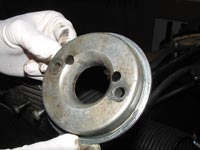 Bell mouth retained from original air-cleaners |
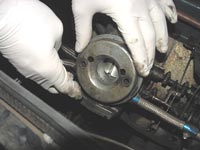 Standard bell-mouth provides ideal induction flow |
Valves used in the B series cylinder heads didn’t have the same wide range of size differences as found with the A series. 1489 and 1588 pushrod engines were 38.1mm inlet and 32.5mm exhausts, rising to 39.6mm inlet and 34.1mm exhaust in the 1622 and 1798 engines. For a couple of years following the introduction of the 18V series of MGB engines, the inlet valve size was increased to 41.2mm. These changes are only modest, showing an 8% increase between the smallest and largest inlet valves and just 5% for the exhaust. By comparison A series engines saw a three times increase during its lifespan, however, this doesn’t give carte blanche to fit redundant dinner plates!
Actual changes in the combustion chamber and the ports follows the advice given with the A series, pointing you towards a specific head tuner with a proven record of accomplishment. The old Special Tuning booklets (red cover first edition) issued by Abingdon’s Special Tuning Dept in the late 1960s advised; “An increase of some 3bhp can be had by general attention to the cylinder head and port polishing.” You would not even feel that extra 3bhp and only know you had it by removing the engine and mounting it on a very accurate engine dyno. You could achieve more than twice that level of power increase by simply bolting on modern performance air filters.
It was that ‘increase of 3bhp’ statement that started one of the world’s top B series tuners, Peter Burgess off on the road to becoming a recognized expert. Peter couldn’t believe that this was all that could be achieved and so he built his own airflow bench using a couple of industrial vacuum cleaners and made up his own manometers which he accurately calibrated. By experimentation and development that 3bhp power gain was increased tenfold. Today proper reworking of a cylinder head should release between 15 and 20% more power throughout the whole rev range for mild modifications and with more work 30% is a very reasonable return, with just minor complementary changes to the rest of the engine specification.
First step modifications to the head should retain standard sized valves, although for the 1489 and 1588cc engines a move to the 1622/1798 valve size would be beneficial. Careful reprofiling the ports, three angle valve seats and minor reshaping of the backs of valves allows for very significant airflow increases. Remembering the base theory covered some issues ago that without airflow you have no power. The actual combustion chambers feature the classic Harry Weslake designed ‘kidney’ shape, which on the pre 1971 18V series engines does have a rather sharp ‘peak’ in the chamber that was smoothed out on the later engines. This modification and other detailed work to blend in the valve seats to the chamber and cleaning up work provides improvements to both flow and combustion. Finally, depending on whether the head has been previously skimmed, an amount of material can be removed to raise the compression ratio to between 9.3 and 9.5 to 1.
Staying with a standard valve size with this level of modification always seems to be less attractive than going for something more ‘exotic’, however the bonus is seen in the improvement in power and torque literally from just above idle speed, and extending beyond peak power speed. Not only do you obtain a power improvement that effectively extends the useable power band of the standard engine, but this careful work also tends to balance up the combustion pressures in each cylinder which then makes the engine smoother. As with most engine and head work undertaken, conversion for unleaded fuel should be automatically included as an essential modification.
Webber 45 DCOE carburettor on B series engine, not a change you need to rush into
MGs using twin 1.5″ SU carbs have more then enough flow capacity to supply the demands of an engine with this modified head, although changes to the needle will be needed and here the facilities of a rolling road will be ideal to find out which needle works best. Standard air filters are restrictive and performance filters can be fitted for a reasonable gain on their own (with a needle change too). Here they complement the modified head and can help the engine move towards a 25% increase. Some slight increase in induction noise will be heard under wider open throttle action, but this is not a huge change.
Moving on from this first level requires more detailed attention to the cylinder head with even more material removed from the ports and in the chamber to unshroud the valves. The limit is the head gasket line; no material should ever be removed where the gasket sits. For most applications, it’s the time to fit the larger 41.2mm size inlet valves of the early 18V MGB engine. This specification of head will still work very well with the smaller 1489 and 1588cc engines. Additional material is removed from the head face to raise the compression to around 9.8 to 1 and when done properly this level of modification will push the expected power gains up in the region of 25 to 30%.
Beyond this stage of tune we are into extensive modification, which still has a place in a road engine but ideally only for those with an enlarged engine capacity. Larger than standard valves did appear in the Special Tuning lists with 42.8mm inlets and 36.5mm exhaust and these, and alternative sizes, can be used, but when moving in this direction the effect on engine power is to reduce the lower rpm outputs and possibly increase the upper rpm power. However, improvements are not going to come from simply fitting the larger valves, but from the alteration of port shapes and size to capitalise on the larger valve’s potential. Improvement is far from guaranteed which is why so few ‘home brew’ modified heads work. Looking at what can be achieved to this point also shows how much progress has been made since the original Special Tuning guidance was published.
Once you are reaching these upper levels of head modification, there is a need for more ‘complementary’ changes to realise the full benefits of your head changes. Performance orientated air filters should be used and once again, the standard 1.5″ SUs still have more then enough reserve to work perfectly well, provided they are in good condition. It’s more important to ensure that other items fitted to the car are working well otherwise they will start to rob power. Exhaust efficiency is a primary consideration and specifically the actual system. The MGA has an efficient 3 branch and the MGB a very effective LCB (Long Centre Branch) design. Most inefficiency is seen in the system attached to the manifold, so here it is important that the system is of a known quantity and quality. A number of good sports systems can be bought in both mild and stainless steel.
Recent changes to UK fuel has caused a significant rise in the number of standard cars suffering from fuel vapourisation problems and even cutting out. This is because the fuel is more volatile and becomes overheated in the standard engine bays. This impacts directly on exhaust considerations, in that the less heat you radiate into the engine bay the better because the exhaust manifold is close to the carburettors and fuel pipe runs. Cast iron radiates less heat and so is better in this respect than tubular steel. Where changing to a tubular steel manifold, I suggest that some form of heat resistant exhaust wrap is used around the first part of the manifold to help reduce heat radiation. I do not recommend that this wrap be used on cast iron manifolds, as cracking is likely.
Other changes from here depend on the original specification of the engine. Distributors if in good condition work very well with their original advance curves. A common change is to fit a performance distributor without vacuum advance. Normally when compared to a ‘like’ condition standard distributor this will not necessarily show the improvements expected, but it can show reduced fuel efficiency. However, as most distributors are changed for worn originals there are usually clear bonuses to be had.
One model that can specifically benefit from a performance distributor is the later rubber bumper MGB. This model, to get through ever more difficult exhaust emission tests, had the vacuum advance pick up point moved from the normal position on a carburettor near to the throttle, to the balance pipe on the inlet manifold. This resulted in a much-changed range of vacuum signals and so simply fitting an earlier specification vac type distributor will not work properly with vacuum connected. You would need to convert the carburettor to take the vac pipe stub, which is not simple. So changing to a vac less distributor can offer greater opportunities for these later cars.
Another relatively simple change is to alter the rocker pivot ratio. The cheaper route is to fit an offset rocker bush in the standard rockers so that the ratio is increased from the standard 1.42 to 1 ratio. Understanding what happens here helps explain how it benefits power. The overhead valve works by the cam lifting the follower, which lifts the pushrod that pushes one end of the rocker up. As the rocker is fixed it rotates around the rocker shaft pivot point and the opposite end of the rocker travels down, presses onto the end of the valve stem and thus opens the valve.
Every 1mm that the cam lifts is amplified by the rocker ratio, so in standard form it moves 1.42mm, so the valve opens more than the cam lifts. If you have ever wondered why there are different measurements for cam lift and valve lift then this is the answer. When the rocker ratio is increased, the aim is to simply achieve more valve lift and so allow greater air and fuel into the cylinders to produce more power.
But, and there is always a but, increasing the ratio of the standard rocker significantly increases the sideways loading that are imposed on the valve stems and valve guides. Rapid wear is known as a result, leading to issues with oil burning and other related problems. To alleviate this a different rocker design has to be used to reduce these side loadings and commonly this is done with rockers with roller tips. These roll over the top of the valve stem and do not apply those side loads. The problem is that these roller rockers are often very expensive. However, on an engine already achieving a 30% improvement, a 7 to 10% additional increase was seen by just fitting a roller rocker set with a 1.62 to 1 ratio, so this can be quite a simple and effective modification. Which helps to illustrate that substantial increases are available by attention to detail.
Roger Parker