LE JOG
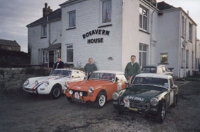
| As the name suggests, LE JOG is a historic rally which runs from Land’s End to John O’Groats. However, it doesn’t take the direct route – a mere 900 miles – but a scenic route of 1409 miles through some of the narrowest, most twisting roads a madman can find. To complete in LE JOG you need to master several disciplines. These include driving at speed around cones for up to one mile in forward and reverse; regularity sections where you aim to drive at an exact average speed for 40 or 50 miles; and navigation sections between plotted points on OS maps. Cars set off at one minute intervals and each discipline is timed – the aim is to arrive at the control points on schedule. Many sections are timed to the second, with one point being added to your score for each second you arrive early or late. Then there are penalties of 60-1000 points for, say, missing controls completely. |
Team Mitey Midge cars and co-drivers at the start of LE JOG. Left to right: 1964 Lenham Le Mans GT, 1972 Midget Atlantis and 1971 Midget. |
There is no winner but crews get Gold, Silver and Bronze medals for keeping to a minimum number of points. Other awards are given for teams according to marque, nationality, all-lady crews and novices etc.
The 1997 entry consisted of 78 cars which ranged from a Bentley S3 to Porsches and Austin-Healeys. MGs were well represented too. Apart from our three Midgets, there was a ZB Magnette; five MGAs (including a twin-cam); an Austin-Healey Sprite; six MGBs; an MGC and a BGT V8.
The one thing the team wanted to do was improve on last year’s results and we had every intention of doing so. However, not everything went to plan and the result was one crash, one retired and one in first in class.
After meeting up at The National Motorcycle Museum in Birmingham, we attached team logos to the cars and listened to the pre-rally briefing by John Brown and his team at the Historic Endurance Rally Organisation (HERO). Talks were given by previous competitors and finishers of the Peking to Paris, giving advice on preparation and survival. If we had only paid more attention.
After signing-on at Land’s End on Friday noon we were given our route instructions. Then it was back to our team headquarters (Bosavern House Hotel) to plot the route and prepare for the most important part of any event – the pre-rally dinner (DJs and Kilts).
Saturday morning at 9:02. We gathered for the start (full of anticipation and with full flasks of coffee). At one minute intervals we launched into the first test around the rocks of Lands End with the sun straight in our eyes, then on to the first Jogularity (regularity), driving at set speeds with various turns along the road and several timing points. For the Jogularity you are given all the relevant junctions, directions, times and distances, so you should arrive at the timing points spot-on. Try it. It’s harder than it sounds.
Then there was the Le Mans test. For this, you get out of the car, wait for the signal, run to the car, start the engine, fasten your harness and blast down a runway, making sure that you stop astride the finish line 100yds further on.
Next followed a road section via various route checks and controls, more tests on MOD sites and regularity’s, then on to the supper halt at Magor services on the M4 to collect the following night’s navigation and regularity details.
During the first leg Mike heard a scraping sound from the rear drums. The supper halt gave him one hour (if he was on time) to sort it. A split pin had disappeared from the handbrake link arm to the shoe allowing the piston to go up behind the shoe. Good job it didn’t go all the way up or he would have had no brakes.
Last year, Gareth’s co-driver Andrea Pope had not slept for three nights before the rally due to a wisdom tooth, so Gareth had to both drive and navigate through Wales, This year the team hoped for better.
Gareth and Neil revelled in the twisty lanes and made it out of Wales with few penalty points, Andrew and Richard had less luck, breaking a throttle cable on the last stage and developed a problem with overheating. Mike and Peter, however, had the worst luck of all.
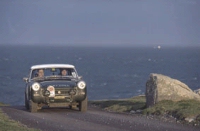 Gareth and Neil aim their Midget straight into the sun for the first test around the rocks of Land’s End. |
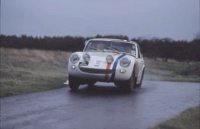 Andrew and Richard flat out through the Highlands of Scotland in the Lenham MG Midget Le Mans GT. |
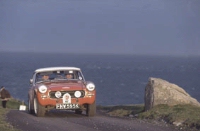 MG Atlantis with Mike and Peter swoops up the hill past the same rocks on the test. |
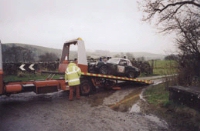 Sad end to a valiant effort as Gareth’s Midget is loaded on the recovery transporter. |
Between TC5 & TC6 (called Old 117 after the one-inch OS map sheet – famous rally country in the 60s and 70s), Peter was calling the roads off the map when he and Mike came to a 90 degree right – what they didn’t know was that it humped on the bend. The road was covered in cow pats and they went up the bank and rolled. Both were OK and managed to get out to warn others, the second car along was team mates Andrew and Richard who helped right the car so it could be driven away.
After a few minutes they noticed the steering was very odd and at the next time control pulled over to check the damage. The left hand bush had been wrenched out of the wishpan, the fulcrum pin was torn almost clean away and the lower end was bent; the wing was a write off and the driver’s window was broken where the wing mirror came through.
So ended the Mitey Midges’ team challenge. The AA were kind enough to get Mike home with a fellow LE JOG competitor (MG BGT V8) who also tried some freelance tree felling in the same area.
After breakfast at Charnock Richard and the remaining team members pressed on. However, exactly 19.22 miles though the regularity section of Gisburn Forest, Gareth’s Midget had to retire with a broken diff and half shafts. Once again, Andrew and Richard were first on the scene and alerted the organisers who called the RAC.
As the only car left in our team, it was down to Andrew and Richard to fly the flag, which they duly did, despite increased overheating problems, needing 3 litres of coolant every 30-40 miles over the last 700 miles and an intermittent starter motor, which involved always parking on a incline.
Stanhope Ford test consists of crossing a 70 meter wide ford, stopping astride a line, switching off the engine, then restarting to pull to the finish. By divine intervention, for only the second time that day the engine fired first time, much to the surprise of Andrew who in his jubilation at starting forgot to complete the test until Richard screamed GO.
Monday morning after the overnight stop at Edinburgh, they set off for the final day and night to the finish at John O’Groats. Routes during the day included tests at Knockhill race circuit and Forestburn hill climb before a superb 25mile off-road regularity through Loch Ard forest. It is only when you drive on the limit, with Colway Rally forest tyres, trying to maintain 30mph on loose gravel, that you realise just how fast professional rally drivers go to obtain average speeds of 60mph.
The rest of the day was uneventful apart from the second throttle cable breaking and a scary 170 degree hairpin which Richard failed to tell Andrew had a drop and low wall on the inside (i.e. do not cut). The exhaust took the impact and the car landed at the time control as the marshal ran for cover.
Through the final night regularity sections were interrupted by an emergency call of nature resulting in a few seconds penalty, followed by some creative driving. But as Andrew and Richard approached the last control we heard Rave music blasting from their car. The rally was over and an impromptu first in class team celebration was held on the road side.
Only 58 cars completed the 60 hours of driving, but 13 MGs did survive, including the Austin-Healey Sprite which finished despite having to remove a brake caliper and disc at Inverness.
Now the team is in the process of repairing its cars but we have entered the Amman and District motor club Historic Rally in Wales during March, so if you fancy a spot of historic rallying, come along. We can’t recommend this rally highly enough – it’s a great introduction.
Gareth Jex
| Gareth Jex and Neil Thompkins | MG Midget – 1971 | Prepared by Alan at ASAP Engineering of Woking (01483 722166). Originally bought as a summer fun car (aren’t they all?). Gareth caught the rallying bug while doing some restoration work and decided to go the whole hog. The car was stripped, everything checked, strengthened, up-rated or replaced. |
| Andrew Down and Richard Lambley | Lenham MG Midget Le Mans GT – 1964 | ‘What the hell is that?’ is an often-heard cry (usually from scrutineers). Based loosely on the 1961 Le Mans Sprite, the Lenham has a Midget floor pan, 1295cc engine, gearbox etc., with a fibreglass GT body, recognisable for it’s cheeky smiling front, the owner alleges most people see it from the rear. |
| Mike Denton-Cardew and Peter Collier | MG Midget Atlantis – 1972 | Prepared during the 60s by Car Preparation at Bedford, they took an MG Midget and transplanted an engine from a Ford Escort Mexico with a Cortina 2000E gearbox and an Anglia back axle. This turned a good sports car into a very good sports car, however it now runs a single 45 Weber carb rather than a twin 40 as original. |