Lunch In Monte Carlo for a Sixtieth Birthday

Lunch In Monte Carlo for a Sixtieth Birthday
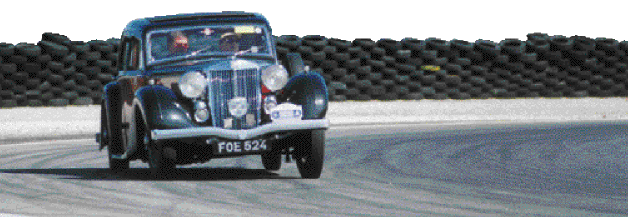
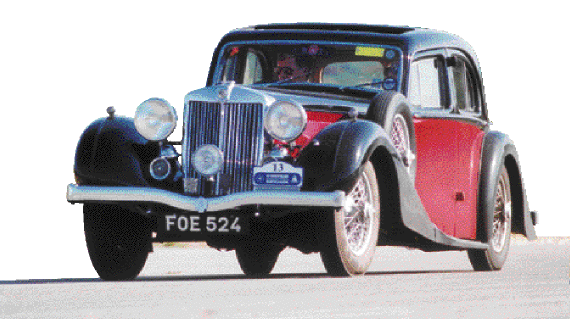
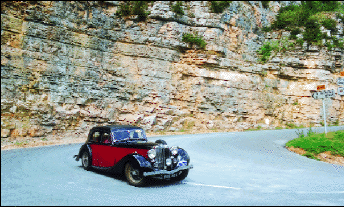
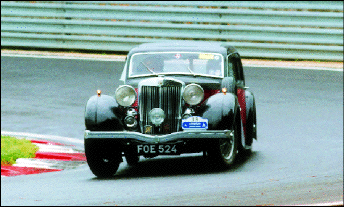
The MG flag was flown proudly on the last year’s RAC Euroclassic. Not only was the Abingdon octagon the most plentiful marque in the two hundred plus entry, our 1938 WA saloon was the oldest MG in the entry, indeed it was a fitting way to celebrate the WA’s 60th anniversary.
As we gathered in the impressive shadows of the Palace of Versailles just outside Paris, a somewhat daunting four-day, 900 mile itinerary lay ahead. Our route would take us far off the beaten tourist track, encompassing some wonderful sights, and a smattering of memorable racing circuits, before reaching the finish line at the Paul Ricard track near Marsailles.
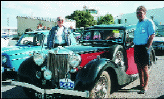
The fully subscribed entry of over 200 vehicles was as colourful as it was varied. Twenty-five MGs were in the entry, including a MG 1300 and a variety of As, Bs and Cs. My father-in-law, Peter Strawson, and myself shared the driving of his WA. It was to be our fifth Euroclassic and each time the WA has accepted the challenge without faltering. This year was to be no exception.
The event is, of course, strictly non-competitive but to complete the route, visiting all the checkpoints in time, is no mean achievement in a pre-war car. It happily cruises at 50-55 mph on reasonable roads, with its 2.6 litre 6-cylinder engine purring way contentedly. Like many pre-war engines, it develops good torque so hilly or mountainous sections can normally be tackled with ease in the style of a pre-war Grand Tourer. Tight manoeuvres are, however, difficult with a 42 ft turning circle! Steep inclines also have to be treated with due care and attention thanks to the WA’s long wheelbase and minimal ground clearance.
Out of respect for the age of our car and its somewhat stately progress we were to be among the very first starters each day. Our official starting time from Versailles on Day one was therefore just after 8.00 am on the Saturday. Although it was wet, it was a great relief to escape the heavy traffic of Paris as we pointed the WA south westwards on the fast French Route Nationale towards Le Mans.
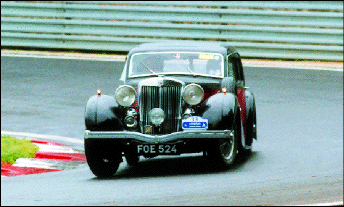
Chartres Cathedral dominated the surrounding flat plain as we approached Le Mans Circuit in time for lunch. Much of the circuit for the 24-hour classic is on public roads and we were able to drive on several sections of the 24-Hour Circuit. We were able to lap the twisty Circuit Bugatti which uses the famous Le Mans 24-hour start and finish section, before turning sharp right after the Dunlop Bridge. The Circuit Bugatti was used just once for the French Grand Prix, in 1967, which was won by Jack Brabham in a Brabham. The circuit has subsequently been used for national race meetings. As we left the Le Mans circuit we quickly visited the Sarthe Automobile Museum which has an evocative collection of cars, naturally including many examples of past Le Mans winners.
The route then took us south towards the Loire Valley eventually travelling along the banks of the Loire, crossing the river near the Chateau at Villandry, then travelling on the opposite bank to arrive at the next checkpoint at Chateau Usse. This is where reality meets fantasy; a fairy-tale castle straight out of Hans Christian Andersen dominates the surrounding countryside and, according to local myth, this was the location for the legendary tale of Sleeping Beauty.
Leaving Chateau Usse and Sleeping Beauty to her slumbers, we continued to the Chateau at Azay Le Rideau and then on to our next checkpoint at the Dufresne Museum. This is a museum covering six centuries of mechanical engineering and included the usual selection of cars, tractors, motorcycles and aeroplanes. But for us the star attraction was a genuine 1792 guillotine from the French Revolution! I suppose a guillotine must be mechanical engineering working on Newton’s first law of gravity…. pity the poor people under it.
Our overnight stop, after covering 260 miles on the first day, was the Futurescope Theme Park, just outside Poitiers. It is full of very modernistic buildings with a lot of the shows on large cine screens, some as high as a seven-storey building. Chrysler, as sponsor of the event, provided a superb dinner at Futurescope followed by a laser light show. We watched this spectacular display from the auditorium surrounding a lake, a system of back projection shooting through massive jets of water pumped from the lake to provide the screen for the show.
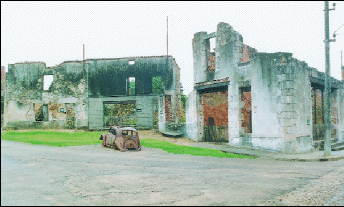
The next morning, Day two, was off to a village that time seemed to have forgotten. 70 miles away at Oradour Sur Glane, the village of Martyrs stands to this day largely unchanged from the Second World War when the German Army of occupation destroyed it and its inhabitants. The tram tracks still run down the main street but the majority of buildings, except the Church, are all virtually destroyed, left as a perpetual monument to Nazi horror. A pre-war Peugeot, gutted by fire, still stands forlornly in the Village Square, definitely not a case for restoration.
Continuing south, we visited one of the most beautiful circuits in Europe Mas du Clos, owned by a Monsieur Bardinon. Alongside the Circuit in a small Museum is his truly breathtaking private collection of Ferraris. The Museum must have one of the most spectacular Ferrari presentations anywhere, apart from the cars it also included Ferrari sculptor and paintings even the floor tiles were specially created in the style of the famous Ferrari Prancing Horse emblem.
The circuit was very twisty and I believe is used mainly by the owner to drive his collection of Ferrari’s. There were several spinners on the damp track, fortunately none on the hairpin that closely bordered the museum.
The route then took us out of the hills towards the Michelin Test Track at Clermont Ferrand. As we dropped down into Clermont Ferrand you could see the vast Michelin Track on the valley floor. Security here was very strong, no cameras allowed, and our passports checked at the entrance to the facility. The reasons for the high level of security were a mystery as it was a Sunday and no testing was taking place. Having driven several laps of the high-speed circuit we continued to Clermont Ferrand City Centre and to a reception with the Mayor.
The next morning, Day Three, the first checkpoint found us at the recently built 2.7 km Issoire Circuit. The circuit had no spectator facilities and appeared to be used mainly by the Circuit Racing School who used a selection of Formula Ford and Formula Renault for instruction. The circuit was long and thin in layout but consisted of some interesting corners and long back straight followed by a hairpin back to the start and finish.
We then followed the route through the Valley De L’Alagnon to Massiac where we climbed up out of the valley using the Massiac Hill Climb Course, which is used for a round in the French National Hillclimb Championship.
We continued south, towards the Mediterranean, through the Massif Central via St Flour and the market town of Laguoile to the Gorges du Tarn. The actual road through the Gorge was like the Alpine passes of the 1950s and 1960s used on rallies like the Liege-Rome-Liege with blind bends, sharp hairpins and a complete lack of any armco or other protection from some very long drops.
Through Millau towards Montpellier, which was our overnight stop, the road now gave distant views of the Mediterranean. The checkpoint was in the centre of the town in the Antigone Centre. We had Dinner near the cars and the RAC Motoring Services were working late into the night – tomorrow was the final day finishing at the Circuit du Castellet Paul Ricard. Another early start saw us driving through the vineyards surrounding Montpelier towards the Carmargue Nature Reserve, a salt marsh area, with its famous white horses and flamingos.
Day four saw the first checkpoint at the Circuit de Ledenon just outside Nimes. There were two circuits; the one we were using was quite twisty with several blind brows, which made for interesting driving particularly for the faster cars.
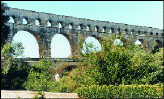
On to the Pont du Gard a very spectacular Roman aqueduct built in the 1st century AD across the Vallee du Gardon. The aqueduct was built to supply water to the town of Nimes. Its beauty is in its simplicity and grandeur. Its sheer height along with the exceptional span of its vaults, contributing to its apparent lightness of structure.
A stop for lunch in Aix-en-Provence, then continuing on to receive our finishers medal at the Paul Ricard Circuit just west of the French Riviera. We were able to use the fast full 3.6-mile circuit, which uses the long, fast Mistral straight, an engine breaker when the circuit was used for the French GP. The Circuit would now need considerable updating to hold another Grand Prix.
The final Dinner that evening at the Circuit was courtesy of Chrysler and then we had to re-trace our route to our hotel in Marseilles. The MG’s 1930’s headlights are limited in power and range, also the big headlamp reflectors are perhaps in need of rechroming. We managed albeit with some difficulty to go, from the circuit southeast of Marseilles to the north side of the city where our hotel was situated. Fortunately, we arrived at our Hotel just as total darkness fell.
Peter had decided we would return home using the Autotrain from Nice to Calais. The following day was free, as the Autotrain did not leave till early that evening. We therefore retraced our route virtually passing again the Paul Ricard Circuit to Cannes and Nice but with time in hand we pressed on to Monaco.
We explored the Grand Prix Circuit passing the Casino, Loews hairpin and parking on the waterfront near the Grand Prix Circuit tunnel. We enjoyed an excellent lunch overlooking Monte Carlo’s small beach.
The Autotrain left Nice station early evening and travelled along the coast through Juan Les Pins, Cap D’Antibes, Cannes and then back through Marseilles yet again and then north up the Rhone Valley to arrive in Calais the following morning.
The car ran perfectly over the fifteen hundred mile trip and averaged about 20 mpg on French leaded petrol. We had no problems with the WA not bad for a car celebrating its sixtieth birthday.
JEFF GIBSON