Magnette ZA/ZB Buying Guide
Buying Guides
Buying an MG Magnette ZA/ZB
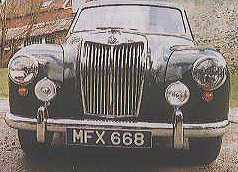
The MG Magnette ZA was introduced in 1953. Despite its handsome lines this well appointed sports saloon was initially greeted with disdain by traditionalists. They complained about the styling and the use of the Magnette name for a saloon car, although the very first Magnettes had been saloons. There were also complaints that this new saloon should not have been given a 1500cc engine before the TF sportscar, which would have benefitted from the extra power. All these criticisms were rather unfair, because Gerald Palmer had designed the body shell in 1952 as a replacement MG saloon, originally it had been intended to fit the 1250cc MG engine. However, a last minute change of plans by BMC turned Palmer’s design project into the new Wolseley 4/44. However, despite so much unfavourable comment at its launch, the Z-series Magnette’s fine handling, comfortable ride and lively performance, soon made the car very popular. Eventually, the excellent Z-series Magnettes outsold all the previous MG saloons built at Abingdon.
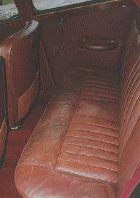
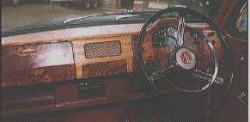 The Magnette ZA had many innovative features, unitary construction, coil and wishbone front suspension, excellent rack and pinion steering and a powerful 1.5 litre engine. The live rear axle was suspended by leaf springs with telescopic shock absorbers. This sound engineering was combined with a high quality interior specification. The Magnette featured a traditional luxury interior, complete with leather seats, walnut dash and even a heater fitted as standard.
 The ZB was introduced in 1956 with extra power, various trim detail changes and minor improvements. An option offered on the ZB was the “Varitone” introduced in 1958, which featured two tone paint work and a larger rear window. These wraparound windows had to be cut out and finished off at Abingdon, because Pressed Steel of Cowley, who made the bodies never tooled up for the larger aperture.
The engine of the ZA was a BMC B series of 1489cc fitted with twin inch a quarter SUs, while the ZB was upgraded to twin inch and a half SUs. The B series engine gave good performance for its time and made the Magnette the fastest one and a half litre saloon available at the time. The gearbox was a four speed unit with synchro on 2nd, 3rd, and 4th gear, with a gearchange that was light and pleasant to use. The Magnette was also offered with the option of a clutchless semi-automatic transmission, but this model, know as the Manumatic Magnette did not prove to be a great success. Braking was competently managed by a twin leading shoe system using 10″ drums all round, which stopped the car effectively.
What to pay?
Prices for Magnettes depend very much on condition and range from around £2500 for a running example needing a little work, to around £6000 for an excellent original car. Restoration projects can be bought very cheaply, but such cars often require extensive rebuilding and complex welding. Finding body panels can be difficult, although some repair sections are available, they may need extra work to make them fit correctly. Exterior trim parts can be very hard to locate. Try to ensure that the car you buy has all its chrome trim parts. Fortunately, mechanical parts are reasonably easy to obtain.
What to look for?
Body condition is vital. Be sure to check the body thoroughly for corrosion damage. Take a torch with you for illuminating all the hidden recesses of the underside.
- Examine under the sill sections, especially the welded seam where the inner and outer sills are joined.
- Suspension mountings must be sound. Check the front coil spring seats and around the rear spring hangers.
- Front wings corrode along the top edges, around the headlamps and along the leading edge above the front bumper. Look inside the front wings. Mud can build up beneath the bolt-on splash panels and trap moisture, eventually causing internal corrosion.
- Floor sections are vulnerable. Always lift carpets to inspect floor pans and also check floors from underneath.
- The boot floor can rot away and the bottom lip of the boot lid can rust.
- Doors can trap water, which seeps in after the window ledges have corroded.
- Exterior trim parts, particularly the ZA hockey stick shaped wing trims are very hard to find and difficult to repair if damaged.
- The condition of the interior trim can be badly affected by water leaks. The wooden dash can warp or rot and become discoloured by the sunlight. It is important to note that if the seats are in poor condition, a complete new set of leather covers will cost a great deal of money to replace. Replacing the headlining material is a skilled job and can also be expensive.
- Mechanically the Magnette is very robust and shares many engine parts with the MGA, therefore exchange components are available and reasonably priced.
- The combined brake and clutch master cylinders are prone to internal corrosion and are expensive to restore.
Road tests
The contemporary American car magazine Road and Track admired the Magnette’s “surprisingly opulent interior”. They particularly liked the quality of the ride which was described as “a little on the firm side,” but they concluded that “this no doubt contributed to the Magnette’s better-than-average cornering characteristics.”
The Autocar described the Magnette as “extremely comfortable, good looking and safe.” The engine was described as “willing to work hard and smooth.”
Family car for the classic MG enthusiast
If you can find one with a sound rust free body, the good looking Z-series Magnette will provide competent MG transport for the whole family. It is a genuine sports saloon and good examples are highly desirable.
Richard Ladds