Midget Owners can now count 123
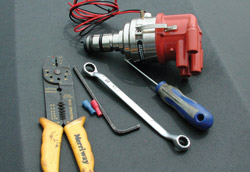
The attributes of the 123 Ignition have already been covered in these pages but A-series Midget owners have been disappointed in being denied the benefits until now. The problem was that until now a ‘side entry’ distributor cap that is used on the standard Midget distributor has not been available. The side entry cap has the HT and ignition lead connections emerging at 90 degrees to the top of the cap, which provides the necessary clearance for the steering shaft.
Tools for the job
Electronic ignition has been around for over 30 years and applications for older cars simply replaced the points and condenser with an electronic switch. By the late 1970s production cars were adopting distributors that came with electronic switching as standard. This was a milestone because increasing the switching accuracy provided long term consistency that had been impossible with points. Electronic ignition has always provided quantifiable improvements over the points distributors and remains a popular and effective conversion today.
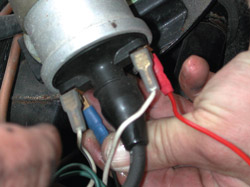
Wiring the 123 to the coil
One major misconception that persists is that these kits are often regarded as ‘electronic ignition’ when in truth the only electronic element is the coil switching. The actual timing of the switching of the coil is still governed by a mechanical bob weight and spring arrangement in the belly of the distributor, usually added to by the influence of a vacuum advance unit. It’s worth making the point that anyone fitting an electronic ignition conversion to their distributor must give serious consideration to the condition of the distributor. Often distributors with wear are given conversions and whilst there will be improvements, usually quite noticeable from the fact that inaccurate and varied switching is now performed more accurately, there remains a degree of lost efficiency from other wear.
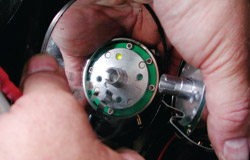
Using a mirror to see the timing adjustment
Mechanical distributors also suffer from mechanical tolerance where even new or rebuilt items will not be consistent. There may not be a huge degree of variation but it will have an effect on the efficiency of the system. Add any wear into the equation and the effect on the way an engine runs can often be very marked.
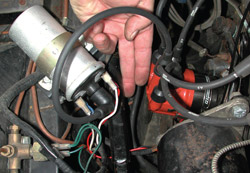
Space between distributor and steering column
Therefore anyone thinking of an electronic ignition conversion should also be thinking of buying a new or reconditioned base distributor in which to fit the electronic conversion. This then adds up to a significant sum, but I mention it now as it is very pertinent to compare this expenditure to the cost of a 123 as many people compare the 123 to the common electronic ignition conversions and it most certainly is much more. Indeed the 123 is better than a new distributor and electronic conversion and here’s why:
1. A 123 is a completely new unit, the only moving parts being the main shaft with a sensor simply reading the rotation of the shaft to provide engine speed information
2. Engineering tolerance is much finer than on traditional distributors which of course in MG terms were designed at least three and a half decades ago
3. The ignition timing settings are held within memory of the electronics, and so with full electronic control coil switching accuracy is far better
4. Being digital there is room for 16 different timing ‘maps’ which means that many variations of the model and even tuned engine requirements are catered for at the turn of an adjuster
5. Vacuum advance is also catered for, if needed, by way of a pressure transducer that accurately reads the pressure (vacuum) and with no degradable rubber diaphragm causing variations of reaction, digital control provides a clear advantage
6. The unit is not voltage sensitive so can be used on standard and ballast type systems. However, it’s polarity sensitive though so can only be used on cars with negative earth, just like all modern electronics.
Fitting is simplicity itself and no more complex than changing a standard distributor, HT leads and setting the timing. Electrical connections are confined to just two wires, a red (coil positive) and black (coil negative) which are simply trimmed to the correct length so that they are clear of the HT leads and steering shaft. Fitting instructions come with every kit but the attached images give an indication on how a 123 was fitted to a 1275cc round arch Midget.
This test car was already fitted with a new distributor and Luminition electronic conversion which had not covered many miles so the comparison was a good indicator of the benefits of digital over mechanical control. Obviously replacing a used and worn distributor will give a much greater benefit. There was a clear improvement in the smoothness of the engine with the 123 at both idle and up to higher rpms, especially with a lighter throttle. Full throttle operation did not provide a noticeable difference, but then the previous distributor was as good as you could get.
These relatively small but significant improvements may seem disappointing, but then I come back to my earlier point of comparing like for like and remembering to compare the costs of any 123 with that of a new or rebuilt distributor AND also an electronic conversion. This will show that most of the traditional options are more expensive than a 123, yet offer less!