The Modern MG Engine part 2
Engine redesign and two larger capacities…
There was no MG K series variant until the arrival of the MGF in 1995 and for this model there was to be a new version of the engine requiring a comprehensive development of the K series engine range.
Prior to 1994 there had been some changes to the ancillaries of the engine with predominately a move from carburetors to fuel injection with total engine management control. This was needed with the widespread introduction of three way controlled exhaust catalysts from 1993.
Competitive though the 1.4 was, it didn’t fill the developing void for larger capacity engines. Honda was the supplier of 1600cc 4 cylinder and 2700cc V6 engines for many Rover models. These engines were, in Honda terms, obsolete, and had been replaced in their own models, but that didn’t stop them charging a high price. By this time the only other compliant current engine was the T16, which only came in 2.0 litre capacity, although as it was based on the O series it could have adopted the 1700cc shorter crank throw to give a smaller and sweeter revving T16.
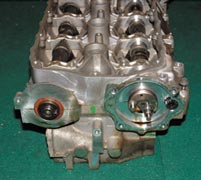
VVC head showing inner and outer segments of half the inlet cam
The T series though, like the O series was bulky and heavy and more of a modern twin cam 16 valve head plonked on an older cast iron block, not ideal, especially when laid next door to the K series. Clearly, with this world leading design it was logical to examine its development potential, even though Rover’s own head of Powertrain said at the 1989 launch that a larger capacity than 1.4 was not possible.
Created with a maximum displacement of 1400cc, through the 75mm bore and 79mm stroke in a very compact block, there was no apparent room for further development. However, using innovative techniques it was possible to fit liners with an 80mm bore that with the 79mm stroke gives 1589cc. This new configuration was described as using ‘damp liners’ as it used elements of both wet and dry liner engines that were needed to enlarge the bore within the already very tight dimensions of the K series block. This wasn’t all, as the engineers also developed a crank with a longer 89.3mm throw that raised the capacity to 1796cc when used with the 80mm bore. At a stroke the new 1600cc and 1800cc variants filled the gaping hole between the existing 1400cc and 2000cc T series engines with a modern design.
Not just bigger capacity but even more advanced developments…
Interesting features continued with the innovative use of plastic for the inlet manifold and the throttle body. But this wasn’t all, not only were there two new ‘K’ series capacities, there was yet another leading edge design introduced in the form of the VVC (Variable Valve Control). Here, in simplistic terms, the inlet cam is driven in a conventional way by a flexible belt, but the cam is split into four pieces, each with a degree of individually controlled movement that allows variation of valve control for each cylinder. The clever bit is how the inlet valve opening period for each cylinder is controlled by the ECU anywhere between 220 degrees and 295 degrees. The exhaust cam is a standard ‘solid’ design.
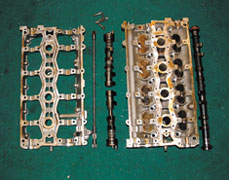
VVC head showing inner and outer segments of half the inlet cam
Interestingly the first research on variable valve control for the ‘K’ series engine commenced in 1989 under the project name of ‘Hawk’, but it was not until Easter of 1993 when the first test engine was running. Needless to say, the results were positive and the engine was authorised for development and production.
To provide some perspective the standard K series uses standard ‘solid’ cams that have a fixed 252 degree duration, which give a good mixed spread of power and torque. For road tuning, cams are often changed for examples that give 270 or even 280 degrees duration. Such a change can result in a reduction of power and torque at low to mid rpms and a rise of power and torque from mid to high rpms. The VVC with its 75 degrees of variation can adapt better, resulting in an ability to maintain good low engine speed power and torque along with significant increased power at high rpms, and clean emissions.
The new engine’s power benefits were interesting. The 1.6 delivered a modest 8ps more than the 1.4 at 111ps, but a more useful 14% more torque over the same rev band. The 1.8 gave a similar 9ps increase over the 1.6 to reach 120ps, plus more importantly another 14% increase in torque. The VVC broke the mould slightly with a hefty 25ps increase over the non VVC 1.8, but only a modest 5% torque increase. With the VVC was a character change in terms of where the power was being developed, with the peak power point at 7000rpm, beyond the rev cut out limit for the other K series. This is some 1500 rpm higher than the peak power point for the normal 1.8, even 1000rpm above the 1.4 and 1.6 power peak points. Note that more recent legislative changes have resulted in a slight reduction of power for some models.
Externally all engines used the same block and were dimensionally identical. The non-VVC engines were also visually identical and only reference to the engine number prefix would show the capacity, 14K4, 16K4 or 18K4. The VVC was visually different with the extra parts needed for VVC operation and a different alloy manifold, which helped increase overall weight.
The first applications for the 1.8 and the VVC engines was in the MGF and this was the sole recipient of these engines for some time, allowing it to be accurately described as an MG engine. Since these were more powerful than any previous K series engine, the R65 gearbox was deemed unsuitable, even though an uprated version was created for cars using the 1.6 litre version. The new gearbox was in fact the well proven and efficient PG1 gearbox with a new end casing to suit the K series. This gearbox, first seen with the Montego 2.0 litre, had developed and become the standard gearbox for Rover 2.0 litre cars and remains in volume production today, although even more developed.
The phrase ‘Racing Improves the Breed’ is often used to help justify and connect everyday road cars and somewhat extreme race or rally versions, which apart from the silhouette and name badges often share little. However, in the case of the MGF, several comprehensive race series certainly did create a number of specifications that have been seen on road versions.
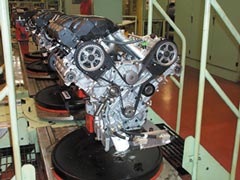
KV6 cylinder head castings
One interesting fact was that the VVC with its higher-powered engine was not picked to be used in the race series but that the base 1.8 unit was chosen to be developed. VVC complication and cost of alteration was the driving factor when compared to what could be achieved with the standard cam arrangement engine.
A positive development was a specific ‘Motorsport’ intended cylinder head, which took on board the much better VVC valves and ports, but incorporated these into a standard cam head design. As effective as this was, and still is, it has not yet been incorporated into any standard production K4 engine to date, so remains quite rare and is usually expensive and known as the ‘motorsport head’.
New V6 engines…
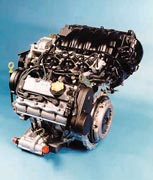
1994 saw BMW surprise many British car enthusiasts when they bought Rover and, unknown at that time, was that little was to happen in until 2000. In the meantime, the only K series engine development issue of note was the replacement of the ageing Honda V6 in the Rover 800 with a new V6 version using K series design hence its designation of KV6. This was another in house project specifically commenced to develop the new V6 engine using a wide range of internal parts from the 4 cylinder K series range.
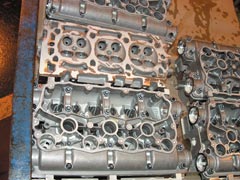
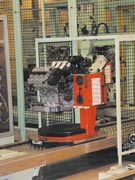
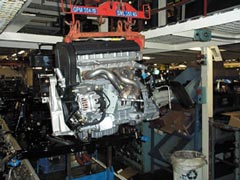
KV6 on production line
Just like its four cylinder siblings, the V6 engine was an all alloy construction with compact dimensions and a weight of just 154kgs. Even with a 90 degree Vee configuration, compared to say the narrow angle VW Vee engines with just 15 degrees, it was still ideal for tight FWD applications. The advanced through bolt construction was not possible but the idea of incorporating the lower half of the main bearing caps into a structurally strong ladder frame is carried over, and the liners are common with the 1800cc engines.
Above the head gasket line, the heads share the same valves and ports as used with the VVC, but without any of the VVC mechanism, although the belt drive uses the same principles of a belt drive at each end of the cylinder head. Cost and complication of VVC for two cylinder heads and six rather than 4 cylinders may make VVC a permanent non starter for the KV6, although there is a constant demand for both more low down torque and greater top end power. Increases in capacity would be desirable to get closer to mainstream competition, which is now sitting with 3.0 to 3.2 litre capacities, but beyond about 2.7 litres is on the face of things beyond the scope of the current engine. However, enlarged capacity beyond 1.4 was supposedly not possible for the K4, and look where we are now.
 |
 |
Married to the 80mm bore is a crank throw of 82.8mm resulting in a capacity of 2497cc. In this form and originally controlled by a Rover MEMS engine management system the engine delivered a very competitive 177ps at 6500rpm and was fitted into the Rover 800 replacing the slightly less powerful Honda V6.
The 800 received the new KV6 in 1996 but by this time a new engine was patently not enough. The 800 replacement arrived in 1999 as the award winning Rover 75, although not without some unforgivable public sniping by top BMW management at launch time (perhaps giving a hint towards the events of later that year and early 2000). The car itself was very well developed and the engine choice included the 1.8 litre K series four cylinder engine and two KV6 engines. The 2.5 litres was a modified version of that seen in the 800, with a new variable length inlet tract and a Siemens engine management system, amongst other changes. Accompanying it for the first time was a new short stroke version of this engine with a 66.2mm crank throw, giving a reduced capacity of 1991cc. Although this two litre may have had six-cylinder smoothness it was also noted in road tests for the lack of low engine speed torque. In the 75 the engine was mated to a Getrag 5 speed manual, plus there was also an automatic option from Jatco.
New Millennium, New Issues…
The start of the 21st Century was traumatic for Rover with BMW cherry picking a few choice products and staff from the company, before selling off most of the rest that they didn’t want. MG Rover, as it was shortly to be named, was created out of the dust and debris and centered on Longbridge, Birmingham, with Ford taking on the Land Rover operation. The first few months saw much consolidation activity and some impressive work by MG Rover, like the rapid transfer of the whole Rover 75 production line from Cowley to Longbridge.
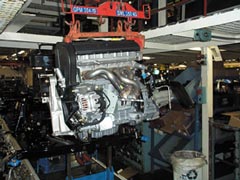
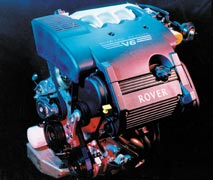 KV6 for Rover 825 application |
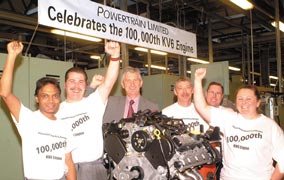 Powertrain’s 100,000th KV6 |
There were now some horrendous conflicts to overcome, as what was previously a single company was now three, each with different aspirations. Prior to May 2000 the K series engine was made at the Rover Group Powertrain Ltd’s, Cofton Hackett plant next door to the Longbridge assembly site, and engines were transferred between the two sites. Cofton Hackett also made engines for the Solihull built Land Rover Freelander as well as gearboxes for both Longbridge and Solihull. Suddenly, Powertrain was not just another part within the Group, but owned by BMW and an outside supplier, selling engines and gearboxes to both MG Rover and Land Rover. Talk about rebuilding Berlin style walls.
Anyway as we know, this situation was to be resolved in May 2001 when ownership of the Powertrain business passed into the ownership of MG Rover Holdings, less the R65 gearbox manufacturing facilities, which BMW retained for their Mini. This then became Midland Gears and saw another wall built. As the R65 was used in many up to 1600cc K series Rover cars, so MG Rover remained a customer for the next couple of years before dropping the R65. Of note is that Midland Gears is due to close permanently in mid 2004.
Continuing to use the K series engine in the MG Rover ranges was not a matter up for discussion, connsequently there were obvious advantages for bringing the engine-manufacturing element back under the same umbrella. Clearly, having control over cost and development gives a freedom that is not possible as an engine customer, especially as whoever you buy from is likely to be a bigger player than you.
Whilst the corporate ownership aspects were on going, so was a programme of K series development, the high profile part of which would be seen in MG branded products. The first release relating to how positively MG Rover would treat the MG brand was in the form of a pre Christmas 2000 picture of the new MG ZT, at that time simply referred to as the X10. Engine wise the information was circulating of circa 200ps spec 2.5 KV6 just to whet the Christmas appetite.
Early 2001 saw full details of all three MG saloons, ZR, ZS and ZT, plus two extensions of the current MGF range, one a new 1600 entry-level model, and the other was a new 160ps version of the current 145ps VVC engine. The 1.6 litre MGF was the first MG application for the 1600 K series and as installed it delivered 112ps. Real interest though was in the new Trophy 160 SE, as here was a factory version of what many MGF owners had been doing to their VVCs for several years.
Improved breathing through reducing intake restrictions and fine-tuning the exhaust was the key. Whereas owners tended to go for a noisy type of bolt on sports air filter and exhaust, the factory version involved using a modified cold air intake system, new 52mm diameter all alloy throttle body, and slight changes in the exhaust. At the same time, all other K4 engines adopted the alloy type body, but with the original 48mm throttle size. The reason was to overcome the warping occasionally seen with the old style plastic throttle bodies, especially when the original difficult to refit hose clips were replaced by simpler jubilee clips that could be very easily over-tightened.
Whilst constant small changes, and in the case of adoption of MEMS 3 control; bigger changes, were and still are ongoing, significant changes to production engine performance have been fewer. The first to mention is the 136ps spec TF 135 unit that uses the VVC 160 inlet system and alloy manifold, including the 52mm throttle body, plus some cam and engine management changes. The effect is quite dramatic in that not only is the power raised by a useful 16ps, but the point at which both maximum power and torque in the rev range is also raised significantly. This provides a much more sporting character and in some ways is surprising that it has not also percolated into at least the ZR.
The next to mention is a quite significant development as it enters a completely new area from where there are very significant public expectations. This is with the first production version of a forced induction K series. This is far from the simple application of creating a new exhaust manifold and taking an existing turbo from someone else’s shelf, bolting the two together before trying to smooth out as many glitches as possible and then fitting it into a stripped out road racer that can hide the many rough edges of such an installation. No, in this case, we see the development of a turbocharged version of the 1.8 K4 for use in the up market Rover 75 and MG ZT ranges, certainly not cars that would hide the shortcomings of a cheap and cheerful turbo conversion.
The intended use for the turbo engine shows in its spec where the maximum power is produced at the same 5500 rpm as the naturally aspirated version. Torque peak though is actually produced several hundred rpm below the torque peak rpm of the naturally aspirated version at 2100 rpm. The other aspect is that the boost pressure is kept low to reduce the discernable differences between off and on boost driving conditions. Even so, the peak power of the MG spec turbo engine matches the most powerful production K4 engine to date with 160ps, however, the 160 VVC produces it’s power at 6900rpm. Torque though is much higher than any previous K4 with 215Nm. Of interest is that the Rover 75 version of the engine produces 10ps less than the MG version, but the same torque.
| K4 Current Models | ||
| 1.4 | 103ps | ZR 105 |
| 1.6 | 109/116ps | ZS 110, TF 115 |
| 1.8 | 117/120ps | ZR 120, ZS 120, ZT 120, TF 120 Stepspeed |
| 1.8 | 136ps | TF 135 |
| 1.8 | 160ps | ZT 160 1.8T |
| 1.8 | 160ps VVC | ZR 160, TF 160 |
| KV6 Current Models | ||
| 2.5 | 160ps | ZT 160 |
| 2.5 | 177ps | ZS 180, ZT 180 Sports Auto |
| 2.5 | 190ps VVC | ZT 190 |
Whilst this engine may have been developed from market pressures to deliver high power with low CO2, and perhaps to answer the lack of low speed torque of the 2.0KV6, it is the first step into the forced induction field. Having taken that first very big step, it is often only a matter of time before someone turns up the boost. Looking at the similar capacity VW turbo engine gives a clear view as to what public expectation is for the 1.8 turbo K4, quite whether the path it will follow will have similarities to VW’s comprehensive use of their turbo engine we will have to wait and see.
The expansion of the MG range has seen a wide range of engines under MG bonnets in various stages of tune. So, at the end of 2003 the K4 and KV6 range fitted to MGs is as show in the table on page 13.
160 ps VVC engine
MG applications are wide, but overall the engine applications are wider still. Many people have a perception of the K series being the product of a small volume cottage industry, and according to a narrow section of the media most will break down. In fact, to date nearly 2,500,000 K4 and 140,000 KV6 engines have been built so such negative viewpoints should, if true, result in huge numbers of K series engined cars at the side of the road. As this isn’t the sight you see I leave you to draw your own conclusions. Two and a half million cars is a significant number whatever the badge.
The MG application is far from the full range of engine tunes seen with the K series as various other car companies are supplied with engines, Lotus and Caterham for example. Here alternative spec engine tunes have been available for some time but these, even though they are well proven, have not been adopted for any MG application.
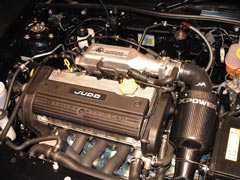
One of the most recent K4 engine developments is the K2000, which as the name implies is a 2.0 litre version. This was announced at the start of 2003 as a competition orientated programme but with distant possibilities of wider use, depending on results. The programme is handled by an outside company, Engine Developments Ltd of Rugby. That name may mean little to most, but perhaps Judd Formula 1 engines should mean more, as it is the same company. With such a pedigree much is hoped and expected of the new engine and towards the end of 2003, the first versions of this tuned engine have appeared under the bonnets of several competition ZRs, and have shown promise with 220bhp specs.
The Judd engine is created from brand new standard engine castings and has a displacement of 1997cc achieved through unspecified increases in both bore and stroke. As announced the Judd engine will be set to develop up to 250bhp in customer form and attracts a price from £12,900 plus vat, which is guaranteed to restrict demand.
Just twelve months after the initial announcement of the K2000 engine programme, again at the Autosport International show, the first road compliant K2000 engines were announced. This time the engine was part of a complete vehicle package and was in the form of the MG ZRX a complete modified vehicle obviously based on the MG ZR. In this specific application the K2000 engine was using the original production alloy inlet manifold and 52mm throttle body leaving the engine bay looking remarkable standard. However, the power output was far from standard with 210ps and with such an increase the brakes and suspension of the vehicle were part of the overall package to maintain the MG motto of ‘Safety Fast’. Price for this version of the engine is approximately a third reduced from the original at circa £9,000.
 KV6 for Rover 825 application |
 |
Not that Autosport 2004 was just about the K2000, as long time K series tuner PTP Ltd also announced their own version of a 2 litre K series engine. They did not stop there and also introduced a 1.9 litre option, and a brand new head casting that out of the mould flows air better than the old Motorsport casting and provides a significant power gain as a result. Following the same basic principle of high efficiency ports and VVC size valves this head, called Vulcan, uses the standard NON VVC solid cams to leave owners with a wide choice to select according to application. At around £1000 per bare head, this offers owners a serious option rather than follow the labour intensive and as a result expensive modified standard head route, or equally costly VVC head conversion.
The first diesel power production MG…
Whilst discussing the available range of modern MG engines I can’t leave out what to many was the most controversial, the announcement of the first production diesel powered MG in the summer of 2001, with the ZR and ZS Turbo diesel models. Whilst most of Europe had clearly taken on board the diesel, the UK perception was still somewhat fixed to smelly and smoking commercial vehicles and trains. Perhaps this is why a diesel version was not immediately available to drive at the UK launch?
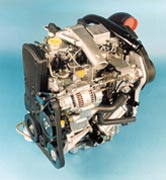
The engine used in the ZR and ZS is the 1994cc ‘L’ series diesel, which first appeared in 1995 in Rover 200 and 400 engine bays. It is a direct injection turbo and intercooled engine, delivering a solid 101ps and 240Nm of torque at usual low diesel rpms. The engine was developed from the effective ‘O’ series diesel first seen in the Maestro and Montego, this engine having very many family connections and commonalities to the ‘O’, ‘M’ and ‘T’ series petrol engines mentioned before. In its 1995 form the L series was among the class leaders, with very strong torque and good economy, but by the start of the twenty first century it had been left behind by others. It still gives a strong account for itself, but has too many old style diesel characteristics, and is not perceived as a sporting engine, a perception that has grown with time and as newer diesels emerge.
The mid term adjustment to raise power and torque to 113ps and 260Nm to power the 115 models does help in the performance area, but unfortunately amplifies the cruder aspects of the engine also. There is clearly great potential to bring the ‘L’ series completely up to date by using common rail injection amongst other updates, and to be fair the sooner the better.
In a better position is the ZT CDTi which uses a bought in BMW multi valve turbo diesel engine also of 2.0 litre capacity, but which has the benefit of many of the features needed by the L series. In base form it arrives with 116ps, 15% better than the base L series together with stronger 260Nm of torque. There is also an uprated version of the engine with a class competitive 131ps and 300Nm of torque. Unlike the L series the upgrade doesn’t carry the same negative changes.
Return of the MG V8…
From the initial launch of the Z range of MGs came the confirmation that there would be a very high performance rear wheel drive V8 engined version of the ZT, and following on from the acquisition of the former Qvale Mangusta sports car production facility in Italy a brand new range topping V8 super coupe, to become the MG SV.
Both ZT and SV use versions of the Ford modular range of V8s that start at 4.6 litre and work upward to 6.0 litres. The term ‘modular’ describing the use of common components that can be used across a range of engines to reduce overall costs.
This V8 is a very popular and cost effective engine, used by many small specialist car makers around the world, and now it has perhaps taken up the mantle of being the engine tuner’s favourite, so it’s not that surprising to see MG Rover select this unit. Certainly, versions are also seen under the bonnets of many familiar specialist UK sports cars. One advantage is that it can come as what is known as a ‘crate engine’, a complete package ready to fit with everything needed to get the engine to run. It is also a certified engine so it will meet most worldwide standards, all of which make it an even more logical choice.
There will be two basic variants of ZT one with a supercharger and one without. The base version is the ZT 260, which arrived in September 2003 with a 4.6 litre SOHC two valve per cylinder engine and 5 speed gearbox very similar to that specified for the same model year Ford Mustang GT. This is an iron block with alloy head design that delivers a reasonable 260ps and excellent 410Nm of torque. The supercharged model is yet to arrive, and the only version seen in public, the development ZT XPower 500, used a DOHC 4 valve per cylinder engine with a Vortec supercharger. Originally, the production car was to have worn a 375 badge, then 385, to reflect the power output, but since then, the expected badging will probably simply be Xpower and we will have whatever power is deemed appropriate.
Research in the US shows very clearly that this is a common engine to tune and the base 4.6 is said to be ready for modest super or turbo charging with no need for any internal modifications. Supporting this are reliable supercharged Mustangs with from 360 to well over 400 bhp, and in fact a production supercharged Mustang Cobra can be had with off-the-peg 390 bhp and around 530Nm of torque.
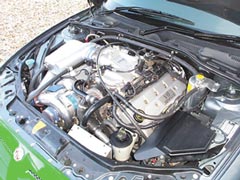
MG Xpower 500 with supercharged 32 valve V8 engine
The SV as a high performance and lightweight sports coupe has seen a need to keep weight down, so here an alloy blocked version of the engine is used along with DOHC and four valves per cylinder, effectively the standard Mustang Cobra production engine. In this form, it produces just over 320bhp and an approx 430Nm of torque. This should be ‘adequate’ for most tastes, but to cater for those with a desire for more then some of the already proven vast array of tuning equipment available for this engine range can be supplied as a ‘factory fit’. Normally up to around 500bhp but for those with deep wallets over 700 will be possible! This should give an indication of the potential of this engine and why it is viewed as the modern equivalent of the Rover V8.
The future…
The twists and turns that we have seen over the years are something that nobody would have been able to predict beforehand, so today at the start of 2004 we have a range of all alloy K series petrol engines in 4 and V6 configuration and the L series turbo diesel that are manufactured ‘in house’. Bought in we have a multi valve diesel and two basic specs of V8. Five completely different engine configurations before you break them down into the fifteen sub variants, and that is just the standard production versions. Overall that’s a really considerable range of engines pointing to a similarly wide selection of MG models to choose from. When has that been seen before?
Roger Parker