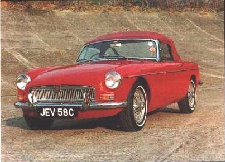
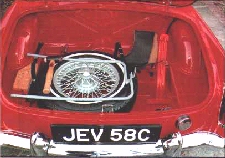
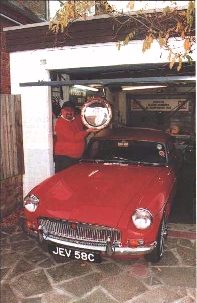
Paul Garett’s 1998 Autoglym concours winning MGB
This B’s the Bizz
| Paul Garett, outright winner of the 1998 Autoglym concours championship, tells Malcolm McKay how he achieved the ultimate accolade with his first ever restoration
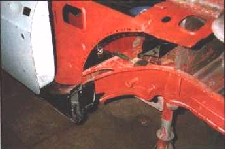
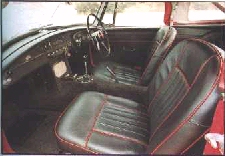
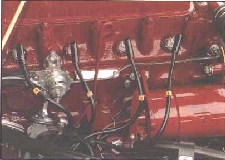
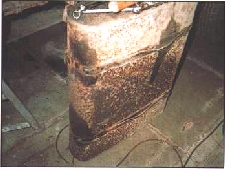
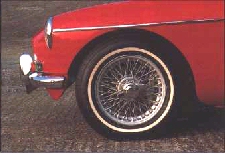
Paul Garett boasts no large heated workshop, no team of mechanics, no collection of gleaming ‘trial run’ cars parked in corners and no string of engineering qualifications. he’s not in the motor trade, he’s not made of money and he’d never restored a car before. yet last year he went out and won the uk’s top restoration accolade, beating people with decades of experience and pockets as deep as oil wells, with a car that he restored himself from a condemned wreck, in the narrow garage tacked on the side of his surbiton semi. how did he do it? “There’s a lot of me in that car,” laughs Paul: “skin, fingernails, blood, tears…an immense amount of time and effort. of course I had help from other people – otherwise I’d have gone round the bend – but only around 10% of the work was farmed out.” Mission, passion and realisation have been the three tenets of Paul’s project: the mission was finding the right car; the passion was: “to get it as near as dammit as it left the factory – except shinier, otherwise it wouldn’t win!” the realisation came at the international classic motor show at the NEC in November. “I get annoyed when people say ‘it’s easy to restore an MGB – you can get all the bits’,” says Paul. “That might be the case with some later cars but it’s certainly not for pull-handle models.” and it was an early B that Paul had to have: “I had a three-bearing B in 1965 when I was 18. I think BL killed the MGB after the pull-handle cars.” This is Paul’s eighth MGB; the previous one was bought after health problems led to a compulsory rest at home that saw him so bored he dug a pond in the garden. “My wife was furious and said I should do something less strenuous, so I bought a near-concours B, did some work on it and won a few prizes. It was enough to convince me to restore one myself, and get it right.” Paul put the word around that he was looking for an early B to buy as a wreck; surbiton MG specialist keith breton said he had one, but it was beyond restoration. “I asked him the date of registration, as 1965 was late for a pull-handle car,” say Paul. “as soon he told me, I said ‘I’ll have it’: It was registered on my birthday – January 1 – and I later found my birthdate is in the body number, albeit jumbled.” This was to be no easy rebuild. the car hadn’t been used since 1980, the driver’s floor was rotted out, the sills had rotted right through, the fuel tank was rotten… “you can’t get early panels at all,” says Paul. “I had to use a later type rear floor, weld it up, fill it and reshape the hole for the fuel tank. when I fitted a new chassis leg in the boot, I had to use a rubber bumper type and modify it. the upper footboard panel and the rear valance were unobtainable and I spent three months pestering mike caldecott at heritage for a boot skin, as the bootlids they supply have the later inner flange which is not compatible. I managed to persuade Malcolm Gammons to part with a pair of new old stock MkI rear wings he was keeping for his own car. The floors came from Steelcraft as Heritage don’t supply early floors, but they had no captive nuts for the seat runners so I had to make a template from another car to get them in exactly the right place.” Needing to replace the original door handles, Paul had a batch of new ones specially cast in brass – by the husband of one of his customers – in order to get the quality he wanted. “I read everything I could find about the cars and about the MG factory and how they operated – David Knowles’ ‘MG – The Untold Story’ was fascinating and Bay View Books’ ‘Original MGB’ was my bible,” recalls Paul. He scoured autojumbles for months: “I found two door embellishers in a heap of bits for 10p each at Ally Pally – you just can’t get them and repro ones are an eighth of an inch too small!” Such problems were common, even to the new door trim cappings which were supplied with half-inch too long foam inside. Paul had to undo the staples and cut the foam down to the right size. Paul did most of the welding himself, using a MIG welder from the Welding Centre: “I made a lot of mistakes, but got there in the end. A friend, Butch, showed me what to do and did the difficult bits like the chassis leg. ” Paul even went to evening classes to learn lead loading: his chosen body shop, Finesse Coachworks of Esher, convinced him it would be best, and he even used it on the inner wings to get the shape and appearance perfect. A friendly panelbeater did give him a hand when he was on his third doorskin and despairing of getting the nearside door to fit: “He told me to go down the garden. I was half-way down when I heard an almighty bang! The door fitted…” Paul handed the body over on a set of chassis tilters he’d borrowed, and it was in the paint shop for 18 months. It received at least ten coats of primer and two-pack paint in all, meticulously rubbed down each time. The underside was painted with stonechip first, as it was when new, while the engine bay was left gun-finish rather than flatting and polishing as some concours fanatics do – but it was some gun finish. Paul reckons it was well worth the wait. While many people decry concours, Paul believes it has a role to play in showing people a car factory-fresh car in every detail. When he bought his wiring loom, it was only available with a white fleck, when it should have been yellow; Paul went through the whole loom, colouring it in with a felt-tip pen. Who else would have bothered? He’s never seen another car with a steady bracket fitted on the dynamo to hold the oil cooler pipe in place, but archive photos prove they all had it originally. The car was originally supplied with rubber mats, which are unavailable for cars with the three-synchro gearbox (they have a narrower transmission tunnel), so Paul ingeniously cut and shut later ones to make exact replicas of the originals, rather than simply fitting readily available – but incorrect – carpets. He had a new petrol tank made, but it didn’t have the original swages. He agonised over repairing the original: “In the end a friend took it out in the garden and threw a match in it,” he laughs. “It didn’t explode, so I MIG’d up the holes and we used a sealant called POR15 from Eastwood in it: it seems to be working!” A concours rebuild was the plan from the start, and it took four years to achieve his aim: “I had a picture of the car as it is now from Day One,” says Paul. “I saw a B with a red hood years ago and thought it looked the bizz – but MG dropped colour hoods in 1967 – the spec of this car as originally supplied was closer to US than UK. Chrome wire wheels look tacky; painted wires are dull but the whitewall brings out the chrome spinner.” Making the car look its best, he reckons, was critical to success. Hairdressing is Paul’s trade and he made it to the top of that tree too, working at Harrods and winning the prestigious L’Oreal Colour Trophy at the Albert Hall (“I was running a Mk1 Jag with no reverse gear in those days!”). Nowadays he runs a salon in Surbiton, but he reckons the experience of hairdressing competitions was a good preparation for concours: “The Autoglym competition comes down to other people’s opinions about what you’ve done, just like hairdressing. When we got to the NEC on Friday, the car looked really forlorn, covered in road muck. I was a bit taken aback by the Ferrari F40 and SS Jaguar – after all, this is only an MGB. The light was bad, so we moved the lights and blew the fuses! I was clipping lights on everywhere; we cleaned it and it changed from a pumpkin – it was suddenly gleaming and other people started to look…” The rest is history. “My next project is to build a 20ft by 20ft garage in the back garden. I don’t want to sell the B unless I’m offered silly money – I wouldn’t swap it for a new MGF – but I’d hate to think it was just an ornament. We’ve done over 1500 miles since last January and will still use it this year, even though it’ll be painted again soon and we’ll probably do the Autoglym Master class. I could do another rebuild; it may be better to do a different make of car, but I’ve found the MG circle so friendly and I fancy an MGA Coupé…” |
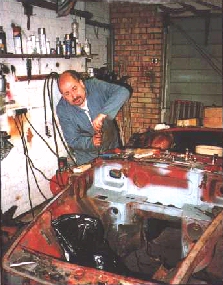
Paul hard at work four years ago stripping and preparing the B. There was rust everywhere
|