Silverstone Here I Come!
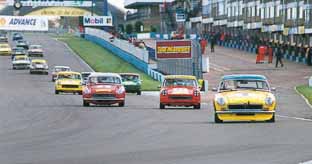
Silverstone
|
Class A offers you the chance to compete in your classic MG |
How many of you have watched televised Motorsport and uttered those immortal words “If I couldn’t do better than that I’d give up?”
Some years ago my father had a friend who raced a Chevrolet Camaro and as it spun off and hit the barriers at Silverstone in the 1972 Tourist Trophy I was certainly guilty of using those fateful words. If only I had realised what it would lead to …..
In 1980 and with by bank account swelled by a two year spell working in West Africa I decided to stop talking about it and show the racing world how it should be done. The big problem was how to start and what you actually had to do to get yourself on the grid. As with most things in life it’s easy when you know how and after racing with the BARC/MG Owners Club Championship for 18 years I hope I can answer the most common questions that potential newcomers ask.
1. What paperwork do I need?
Even if you can afford to buy an expensive race car you will have to get a competition licence before you can enter it into any competitive event. All Motorsport in the UK is governed by the RAC Motorsport Association (the RACMSA) and to get the necessary competition license you must successfully complete the mandatory ARDS (Approved Racing Drivers School) course. These are held at most UK racing circuits and will cost you in the region of £130. The main purpose of the course is to ascertain whether you have a general appreciation of Motorsport procedures and understand the meaning of the various flag signals, this information is to be found in the RACMSA Blue Book which you will get as part of your training pack. The course is not intended to assess your driving ability and the pass rate is apparently close to 100%. After passing the course you will be eligible for a National B licence. Having parted with the first slice of money you now have to decide what to race.
2. What sort of car can I race?
The MGOC Championship has separate races for the following cars:
Class A – MGB, Midget,1275 Midget/Sprite, 1500 Midget.
Class B – 1600 MG Maestro, EFI Maestro/Montego.
3. Where can I get a car from?
There are always a number of ready to race cars for sale, for details of these contact MG Owners Club offices.
4. What would a ready to race car cost?
There aren’t too many Class A cars on the market but a tidy car with some reasonable recent history would cost around £2,500 but expect to pay up to £5000 for an immaculate car with a race winning record.
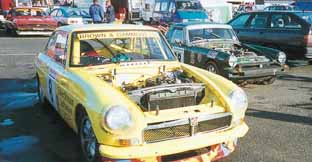
Class A race cars are difficult to find
Class B cars are more readily available and a presentable car can be bought for as little as £1,500 and for a top specification competitive car expect to pay up to £3,000.
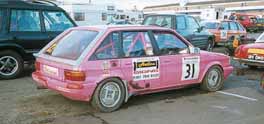
Class B race cars are more readily available
5. Can I convert my road car?
Yes of course, this is relatively straightforward for the average competent home mechanic with plenty of time and access to normal workshop facilities. There are a number of mandatory safety requirements that have to be fitted to satisfy the RACMSA scrutineers i.e.
- Full FIA spec. Roll cage.. £400
- Four point seat harness.. £60
- Fire extinguisher.. £50
- Electrical cut-out switch.. £30
- Competition Drivers seat.. £100
In addition to these mandatory items you will obviously have to carry out significant work to the mechanical components in order to make the car safe and suitable for competition use.
The following should be regarded as a minimum:
- Renew all wheel bearings.
- Fit new brake discs.
- Fit new wheel cylinders.
- Fit Aeroquip braided brake hoses.
- Fit new brake master cylinder.
- Check metal brake pipes for damage and replace as necessary.
- Fit competition specification pads and shoes.
- Drain hydraulic brake fluid and replace with high temperature competition fluid.
- Flush out radiator and replace all hoses.
6. What about the go-faster bits?
There is far more to motor-racing than out and out speed and before spending large amounts of money on ultimate specification race engines you would be well advised to spend time and a lesser amount of money developing the suspension and handling departments. This would include the fittings of lowered and uprated springs and competition specification shock absorbers. Although this may seem a potential minefield for a novice, the regular competitors or any of the specialist MG suppliers will happily advise on what is currently in fashion. Not all performance goodies cost a fortune, very worthwhile power gains can be made by fitting improved air filters and a big bore exhaust system. Neither of these are likely to cost much more than £100. Perhaps the best pound for pound investment is to take your car to a reputable rolling road where for less than £100 the carburettors and ignition timing can be set for optimum power and reliability.
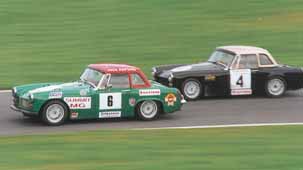
Close racing in Class A
7. What about engines?
Novices are highly unlikely to win a race in their first season and by far the most important thing is to finish every race you enter and gain vital experience as quickly as possible. With this in mind we would suggest that as a novice you should initially refurbish your existing engine, it would be worthwhile checking cylinder compression’s as anything less than 175 psi would suggest terminal wear that could be addressed fairly cheaply. We strongly suggest that in your first year you concentrate your efforts on learning the circuits and how the car handles in a race situation. When you feel suitably confident you can then consider the options for buying a full specification engine. The MGOC Championship has strictly laid down rules that govern what can be done to your engine and although modifications are limited you can expect to pay around £1,500 for a race specification lightened and balanced engine.
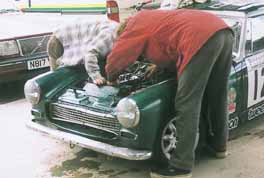
Doing the preparation yourself can save money
8. All of this sounds very expensive?
I suppose we have to accept that motor-racing will never be a cheap sport but as is the case with all MG cars, the component parts are very reasonably priced and if you are able to do the work yourself it really can be done on a very sensible budget. If you chose to have the work carried out by a specialist at a rate of around £30 per hour the costs will obviously increase dramatically.
9. Surely it’s cheaper to buy a race prepared car
It is certainly true that you can buy a car ready to race for a lot less than converting your road car and certainly in the case of a Class B Maestro they are available at almost give-away prices. Good quality Class A MGBs and Midgets are less readily available and currently command high prices and if you have a good sound road car and can do the necessary work yourself you may well find it to be a cheaper route than buying a ready to race car. Remember that racing drivers are expert at blaming someone else when if it all goes wrong and if you have built the car and engine yourself you seriously limit the number of people you can blame…………… A cautionary note for your advice. There are a great many MG Championships in existence most of which have slightly differing technical regulations. If you are offered a ready to race car you must satisfy yourself that it complies with MGOC technical regulations, if there is any doubt you should contact MGOC for further advice.
10.What about tyres?
The MGOC Championship is sponsored by Firestone and all cars have to use their tyres and we have negotiated discounted rates for registered competitors of around £30 per tyre. It is accepted practice to have the tread cut down to 3mm which improves performance and dramatically extends tyre life under race conditions, a novice driver would run a full season on one set of tyres. Most serious drivers have a second set of full tread tyres for wet weather conditions.
11. What about overalls and crash helmets? You must have a set of fireproof overalls and a crash helmet that will comply with the minimum standards set down in the RAC Blue Book. Although not mandatory you should also consider buying fireproof gloves and ankle length boots. If you want to be a real paddock poser you can spend huge amounts of money on these items but you can buy fully acceptable kit for the following:
- Crash Helmet £100
- Nomex Overalls £100
- Gloves £50
- Boots £80
If you have a crash helmet lying in the garage from your days as a biker please don’t take it for granted that it will be acceptable for motorsport.
12. How do I enter a race and how much does it cost?
All MGOC races are organised by the British Automobile Racing Club (BARC) and to compete in the Championship you will have to join as a Racing Member at a cost of around £35 per year. As a member you will automatically be sent race entry forms which need to be filled in and sent back at least two weeks before the race date. You will then receive from BARC a pack of “final instructions” containing circuit entry tickets and a timetable of the day’s events. All you have to do then is turn up in good time, you will always find that our experienced drivers will be on hand to help out and advise. The MGOC Championship has excellent sponsors which keeps the cost of entries down to around £100 per race.
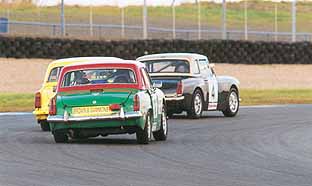
Seek advice on the best suspension and handling modifications
13. What do I do when I get to the circuit?
Your final instructions will show times for scrutinising, morning practice and the afternoon race. The first thing you must do is to “sign-on” this simply involves going to the Race Control office with your license and signing a form which confirms your intention to compete and acceptance of all sorts of circuit conditions and disclaimers. You must then take your car, overalls and crash helmet for scrutineering. These will be checked to ensure that they comply with the mandatory safety requirements as listed in the Blue Book and assuming everything is acceptable you will be given a ticket which you will have to show to the paddock marshal before you will be allowed out onto the circuit.
14. After all this, when do I actually get onto the track?
At the allotted time you will be called to the assembly area and released out onto the track for the timed practice session which generally lasts about 15 minutes. Soon after the practice session ends you should go to Race Control and collect a sheet which will show your fastest practice lap and where on the grid you will start the race.
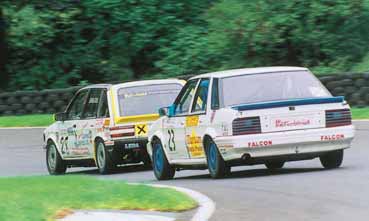
Concentrate on developing driving skills during your first season
15. What about the race?
This is about the only thing we have in common with Formula 1. Racing starts immediately after the lunch break, as for the practice session you will be called to the assembly area prior to being released onto the grid where you will be directed to your allotted grid position. After a three minute countdown you will be sent away on a warming up lap before re-forming in your grid position. As soon as the last car is in position the lights will go red then to green and away you go for your ten lap sprint.
After the race is over you will be directed back to the paddock where it is customary to hold court in front of your admirers and tell then how well you would have done if only etc…
After a lot of time, a fair amount of effort and some money has been spent you will have finally done what you have thought about for years. At this stage you can consider yourself well and truly hooked, I guarantee you will not give up now and on the way home you will start thinking how all those other drivers in “cars just like mine” manage to be so much quicker. The answer, of course, is experience and it’s now that you start planning for the next step on a long learning ladder. I went through this very episode back in 1981 with the intention of doing just one season and here I am some 300 races on and still as enthusiastic as ever.
Rest assured that by the end of your first year you will be telling everyone how it should be done and that motor-racing really isn’t as easy as it looks ….
Jim Baynam