Assault on Batteries
Out of sight
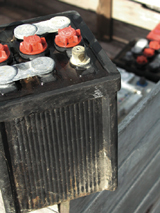
One of the most common potential areas of neglect on an MGB or BGT are the batteries, either the twin 6 volt batteries or single 12 volt in the post Sep’ 74 models. On the MGB these vital components are out of sight and out-of-mind, hidden away beneath the rear shelf or back seat on a BGT. In this secluded position they are often completely forgotten until trouble strikes. For some owners the actual location can remain a mystery until the day when the car fails to start. MGB batteries are not particularly prone to trouble and will last just as long as those on any other car; I’ve only had three sets in 27 years of BGT ownership. However, you must remember to inspect the batteries at regular intervals and ideally the car should be used frequently, or at least started up and taken for a decent run from time to time. If your B spends long intervals in hibernation then it would be well worth investing in a modern trickle charge type of battery charger to keep the batteries in optimum condition.
Inspecting batteries
Try to check the batteries regularly. Take out the rear seat squab and rear carpet on a GT or just the carpet on a roadster to expose the metal battery cover. Using a 2p coin or large flat bladed screwdriver undo the Dzus fasteners that hold the metal cover in place. Lift the cover out of the way and get an electric torch to inspect the battery cells. Remove the plastic caps and using the torch (never use a naked flame anywhere near a battery) check the distilled water levels, topping up if necessary, so that the water just covers the electrodes or reaches to top up mark. Also ensure that all the post connections are clean and correctly secured. My BGT was originally supplied with lead cup type battery post connectors which can lose their contact effectiveness after time, fortunately they are easy to replace with the much more efficient clamp type connectors.
Battery posts
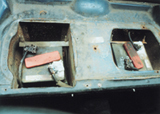
A common fault on MGB batteries is the accumulation of white crystalline deposits (sulphation) around the terminal post and connectors, over time this corrosion will grow and spread until it reaches the metal securing brackets which are essential to hold the battery in place. Once the corrosion has reached the metal bracket, particularly in damp conditions the corrosion can short out the battery to earth via the brackets and rapidly discharge the stored energy, making it impossible to start the engine.
If you find that your battery is corroded in this way, first disconnect the earth and then the positive terminals; the corrosion can then be easily removed by wiping away with a damp cloth or wire brushed away in more severe cases. However, extreme caution must be taken during this operation to avoid getting any acid particles onto exposed skin or in your eyes. Protective goggles and gloves would be a must for this task, also wear old clothing as holes may appear later. Once the terminals are clean then the application of clear grease such as petroleum jelly should prevent further corrosion problems.
Good earth
Another often neglected area is the earth strap to the body connection. This strap is fixed by quite a small nut and bolt. Should the strap or bolt or the area around it become corroded, the earth connection will be poor and will eventually diminish the performance of the battery, affecting its ability to re-charge. In severe cases the battery simply won’t have sufficient power to turn over the engine. Also note that there is another earth strap between the engine and body. If this has badly corroded or not been refitted after an engine change it can also cause starting problems. A symptom of this problem is when the engine will earth through the throttle cable which will rapidly heat up and eventually melt.
Charge
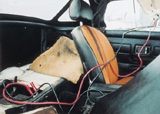
You can charge B/GT flat battery/batteries in situ, although it is easier and safer on a bench. You must remove all the filler/breather plastic caps and charge in a well-ventilated area, because batteries give off explosive gas when charging. When charging in-situ it is a sensible precaution to remove the earth and power leads and always connect and disconnect the charger to the battery posts before switching it on or off to avoid any chance of a spark. Make connection to the outer positive and negative posts, treating the two six volts as one big twelve volt unit. Never put a naked flame near a charging battery nor allow any chance of a spark in the vicinity.
Do you need a new battery?
If the car is not started for long periods there is a good chance that batteries will occasionally run down. However, in my experience when the batteries fail to keep their charge after a decent journey of several miles or after thorough re-charging, then the battery or batteries will need replacing. When shopping for batteries ensure that you always buy a suitable replacement of the correct amperage because an MGB engine needs considerable battery power to turn it over. I am amazed at how long some owners will persist with a duff battery, especially as jump starting a B is not a straightforward task, requiring extra long jump leads and the awkward removal of rear carpet (plus rear seat squab in a GT) along with steel inspection cover. An MGB six-volt, heavy-duty battery is 58 amp hour while the 12 volt heavy duty is rated at 60 amp hour. Ensure that the replacement battery you purchase is heavy-duty type with an extended warranty of more than one year. Obtain batteries that are dry charged with electrolyte supplied for commissioning.
Alternator/Dynamo
If you have a suitable meter you can test the output of the dynamo or alternator to check if its poor performance is the reason for your battery not charging. The simplest check being the voltage levels.
l Under 12 volts – discharged or no charge.
l 12.5 volts charged batteries.
l 13.5 -14 volts Normal system voltage with generator working.
l Under 13 volts with engine running, poor generator.
Replacement
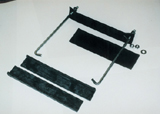
The location of the batteries in a MGB and the metal clamps that secure them make the task of removing and replacing quite a tricky job. However, there are a few hints that can reduce some of the considerable fiddle involved. With an MGB you can at least drop the hood to give yourself some extra room to manoeuvre but with a BGT you have to manage in the tight confines of the closed cockpit. Take the squab, carpet and battery cover right out of the car and also ensure that the seat belts are tied up out of the way. Slide the front seats as far forward as they will go and tip them forward so that you can at least gain some access to the rear shelf. Disconnect the earth posts first and then the remaining posts and tie the battery leads back, so that they do not spring forward into the battery wells. Now for the battery clamps, these are strips of L section held by two locating bolts, threaded at the top and bent to a hook at the end to fit into holes in the side of the battery cages. Removing these is not too difficult provided the nuts are not severely corroded but replacing them can be a frustrating experience. However, they must be fitted as they are an essential safety item and an MoT requirement. An unsecured battery is extremely dangerous and in the event of an accident is a serious fire hazard. Never drive any vehicle with an unsecured battery.
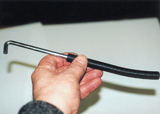
Modifying the location clamps
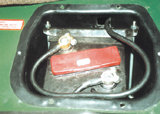
I would recommend this simple battery clamp modification which appeared in the ‘Enjoying MG’ some years ago and was sent in sent in by member L H Le Bas, I have found it most helpful when removing or replacing my own BGT batteries. It requires about 30 cms of rubber or plastic pipe (petrol hose or similar) with 1/4″ inside diameter – 1/2″ outside diameter. Also four stainless steel washers (1/4″ inside diameter – 1″outside diameter) and a couple of 3/32″ stainless steel split pins. Take the securing bolt and push about 15cm or 6 inches of the pipe right along the length of the bolt and then drill a 3/32″ diameter hole about 3/16″ from the end . You can then place the bolt in its locating hole and fit the locating washer and split pin. Now you can fit the L shaped clamp at the top and put the washer and first nut in place and turn it a few turns to locate. Do the same to both bolts in each battery well. This modification will enable you to remove and replace the batteries much more easily by keeping the bracket clamps located securely in place during the whole operation. As anyone who has attempted the task will tell you, when you try to re-fit the battery back in to the well using the original un-modified brackets, the clamp and bolt assembly will frequently come apart and fall into the battery well, usually down beside the battery from where it cannot be easily retrieved. A complete kit of new battery clamps, rubbers, bolts, nuts and washers is available from MGOC Spares.
Battery cages
MGB battery cages are partly fabricated from L section steel and usually survive quite well despite being quite exposed to the elements and road salt however they can corrode when exposed to acid from leaking batteries. While the batteries are out of the way, do make a thorough inspection of the cages and effect any necessary welding repairs. Also check the condition and location of the thick rubbers that the batteries rest on. MGOC Spares can provide a special durable plastic battery bin which is designed to slip inside the battery cage and provides complete protection from the elements for each battery. Replacement thick rubbers are also available from MGOC Spares.
Battery chargers
If you leave you MGB unused for long periods of time then a battery charger is a very worthwhile addition to your garage. The Accumate Charger-Conditioner is also available from MGOC Spares and will charge a 12 volt or 6 volt battery and even when full charge is achieved it can still be left connected for long periods when the car is stored, float charging the batteries.
Battery cut-out switch
Another problem with MGs that stand unused for long periods of time is the gradual drain on the battery from interior lights and clocks etc. A battery cut-out switch will eliminate this drain, in addition act as an anti-theft device and also as a safety precaution enabling you to cut off power when working on the B’s electrical system.
Replacement batteries
New batteries for all MG models can be ordered from MGOC Spares, they are supplied dry-charged and therefore can be fitted and used straight away.