Sebring Special BGT
Sebring Special BGT
When Tony Fuller first told me about his modified BGT I was initially most interested in finding out more about how he had gone about fitting the Sebring panels. However, when he showed me the car it was obvious that this project was much more than just a body kit conversion. In fact Tony’s Sebring featured so many special modifications that I persuaded him to list all the alterations he had made. Tony explained the evolution of the Sebring, he had originally bought the BGT for his son and it had served well until a brand new company vehicle came along and the BGT was set aside. By this time the car needed major restoration and Tony began the rebuild, after removing the wings he could see that the sills would also need replacing along with the various other body repairs. The BGT had been fitted with a sunroof which was beyond saving, so Tony re-panelled the roof in steel, spot welded in place and sealed with fibreglass.
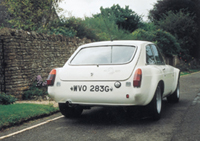
It was obvious by this stage that the BGT would need four new wings, a new bonnet and various other panels. Tony thought hard about the best course of action. Eventually he decided that what he wanted was something rather different and decided to undertake a Sebring body conversion. He felt that as it stood the BGT was a virtual write off and the cost of restoration back to ‘as original’ condition was uneconomic and so Tony’s objective became to produce a high specification, non-original, specialist sports car at minimum cost. Tony had seen photos of the original Sebring cars and had always admired the purposeful looks, particularly the extended wing arches and the wide wheels. The original works cars were extensively panelled in aluminium but these days there are conversion kits available to reproduce the Sebring look in fibreglass.
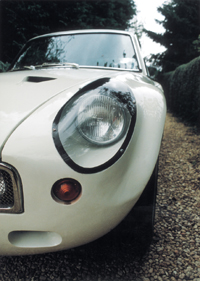
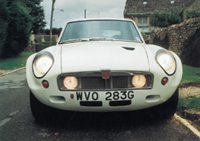
Taking the Sebring panels as a starting point Tony also wanted to add his own touch of individuality to the look of the car. He started by blending the lines of the front and rear aprons smoothly into the wings and also by fitting faired in headlights which were covered with perspex cowls. Tony moulded the special headlight inserts himself with a home-made buck and also fashioned the perspex covers. Headlight units to fit inside the new recesses are 100/85 w backed up by two more 100w lights mounted behind the mesh grille, as Tony found the performance of the headlights was somewhat diminished by the perspex covers.
The bonnet was fitted with a NACA duct to channel extra air in to feed the carburettor.
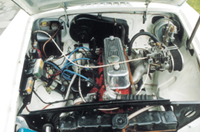
Tony did not stop at the bodywork alterations, as he wanted to create a BGT that had a performance capability to equal its aggressive race car appearance. He decided to fully rebuild the tired engine and squeeze out some extra power at the same time. The engine was over-bored, while the pistons, con rods and crankshaft were all fully balanced. The gas-flowed cylinder head was fitted with large stainless steel valves and seats. Also a fast road camshaft was installled along with a Lucas 43D distributor and electronic ignition. Unleaded petrol is delivered by a 45 DCOE Weber carburettor while the exhaust gases exit via a free flow stainless manifold and system. Power is transmitted through a late specification 4 syncho overdrive gearbox with the o/d switch located on the gearlever.
Along with the performance mods the BGT needed handling improvements to cope with the extra power. Wide wheels were obviously essential to fill out the Sebring arches and Tony opted for 15 x 8 Minilite Replica alloys fitted with 205/55 x 15 V rated tyres.
When it comes to engineering Tony is prepared to make or adapt parts to fit his exotic specification. He fabricated his own double wishbones for the front suspension which incorporated Koni adjustable shock-absorbers. Koni’s were also fitted at the rear and the axle was located by a panhard rod. Braking was also improved by fitting ventilated discs and four pot calipers at the front plus a servo to assist the application of all that extra stopping power. To further firm up the handling all the suspension bushes were replaced by performance polyurethene bushes.
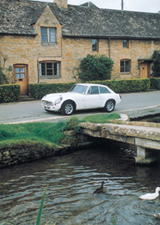
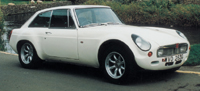
The Sebring is undoubtedly a car with striking looks and when Tony took me for a blast it certainly performed like a race car. Not only is the engine considerably up on power output but all those light fibreglass panels and the stripped out interior make a significant contribution to weight reduction. The fierce acceleration is accompanied by an aggressive bark from the exhaust and the usual induction roar from the Webber carburettor. The engine seems to have an abundance of torque and pulls extremely well. I clearly remember the BGT accelerating hard up a steep hill without a hint of protest. The ride is very firm as you would expect but not too harsh and the supportive rally seats hold driver and passenger comfortably in place, especially when cornering at speed. There is a fair bit of noise in the cockpit as you would expect but the whole car performs so well that all the sounds which emanate from the engine and wide tyres provide a perfect accompaniment to the Sebring’s dramatic progress.
The Sebring is undoubtedly a hybrid and Tony was determined to turn the basic BGT concept into a modern sports coupe. The Sebring shares a garage with Tony’s Lotus Esprit Turbo, so it’s clear where he derives his inspiration and his thorough understanding of fibreglass and its potential for modification.
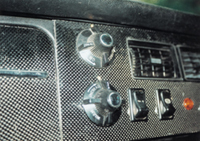
Typically Tony also added his own individual touches to the interior, including a brace of rally seats, even the dashboard has been re-faced with a thin veneer of carbon fibre. The seat belt mountings have also been modified and are re-located on some specially fabricated steel brackets to bring the shoulder attachments high up behind the seats as in a modern passenger car.
Under the bonnet, the electrical system is brought up to date by adding separate relays and fuses to cope with the various added electrical components such as power windows, engine cooling fans, extra lights, and horns.
Tony does not know the final cost of the project and believes it would probably depress him if he did. However, he adds that many of the bits and pieces were obtained at the local scrapyard, items from the following cars have all found a home on the BGT: Jaguar, Skoda, Peugeot, Ford, Vauxhall, Lotus, BMW, VOLVO and even an old Post Office van of unknown parentage.
When I saw the car all the work except the headlining was complete. The BGT had passed the MoT first time and the tuned engine was now fully run in. Since completing the Sebring Tony had decided to re-locate his home to the south of France and has taken the Sebring BGT with him to exercise on those deserted French roads. Tony is looking for a Kilometres Per Hour speedometer which is mandatory for the French MoT and French Registration. If anyone can supply one (left over from LHD TO RHD conversion perhaps) would they please contact me at the MGOC HQ and your information will be forwarded to Tony.
BODYWORK
- New sills and complete refurbishment
- Modified Sebring GRP panels
- Fully faired headlamps
- Internal wiring, fuel and brake lines
- SS mesh grille
ENGINE/GEARBOX
- + 20 thou over bored
- Fast Road Cam
- Large SS valves and hard valve seats for Lead Free fuel
- Large bore single silencer and tailpipe
- Oil catch tank
- Electronic ignition
- 4 Synchro gearbox
- Fully balanced pistons, con rods crank clutch and flywheel
- Clutch also balanced
- Gas-flowed cylinder head
- Free-flow SS exhaust manifold
- Weber 45DCOE twin choke carburettor
- Polished alloy rocker cover
- LUCAS 43D distributor
- Later type overdrive (switch on gear lever)
- 12V Battery fuel pump and filter in boot
- GRP bonnet with NACA duct
- FlA rollover bar
- Gas strut bonnet support
SUSPENSION/BRAKES – FRONT
- Fabricated double wishbones
- Koni adjustable shock absorbers
- Ventilated discs
- SS flexible brake hoses
- Air ducting to calipers
- 205/55×15 V rated directional ZE 502 Falken tyres
- Polyurethene bushes
- 7/8″ Rollbar
- 4 pot calipers
- 1 degree negative camber (fully adjustable)
- 15 x 8 alloy Minilite ‘look-alike’ alloy wheels
SUSPENSION/BRAKES – REAR
- Koni adjustable shock absorbers
- SS brake hose 2
- 255/50 x 15 as above
- Panhard rod
- 15 x 8 wheels as above
- Polyurethene bushes
COOLING/ ELECTRICS
- Electric thermostat controlled fan
- 4 headlights 100/85w and 100w
- Rear window wiper
- Large capacity electric screen washers
- Quality radio/ cassette and speakers
- 13 row oil cooler with SS hoses
- Separate relays and fuses for all lights, horns, fans etc.
- Air horns
- Electric windows
- Roof mounted radio aerial
TRIM
- Carbon fibre dash and modified console
- Leather covered steering wheel
- Seatbelts mounted behind trim at B posts
- Rally seats